
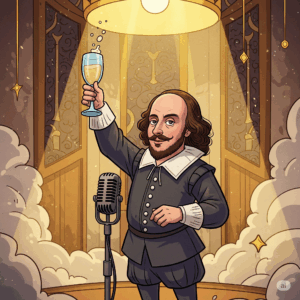
Have you ever found yourself in a situation where you needed to give a toast but had no idea what to say? You can’t go wrong with Shakespeare toasts. Here are a few lines from Shakespeare to keep in your back pocket (figuratively, by memorizing them, or have them written on a card in your back pocket :)) to help you out.
Set It Up
“Shakespeare said.” Remember those words. It may be more accurate to say that Duke Orsino said it in Twelfth Night, but most of your audience will typically not get that. Everyone in the crowd, however, is guaranteed to recognize the name Shakespeare and pay attention to what you’re about to say. Of course, you can phrase it however you like. “As Shakespeare once said…” or “In his romantic comedy Twelfth Night, William Shakespeare wrote….” You get the idea. That’s just a matter of style. Below, each quote cites the character who said it, the play, and the act/scene where it can be found, in case you want to work this information into your Shakespeare toasts.
Openers / Ice-breakers for Shakespeare Toasts
“Men of few words are the best men.”
[Boy, Henry V. Act 3, Scene 2]
“…so, I’ll keep it brief.” Or, if you prefer the self-deprecating style, “Shakespeare said that men of few words are best men. I guess that doesn’t say much for me because I’ve got about 20 index cards of notes to get through.”
“Brevity is the soul of wit.”
[Polonius, Hamlet. Act 2, Scene 2]
This line serves the same general purpose as the one above if you like it better. It’s the more popular quote, so your audience may recognize it. That may make it too cliché for you, though. Judgment call.
“Though I am not naturally honest, I am sometimes by chance.”
[Autolycus, The Winter’s Tale. Act 4, Scene 4]
On the other hand, not too many people will recognize the source of this quote. But hopefully, they get the joke – that you lie so often that when you do tell the truth, it’s probably a mistake. You can then go on to say whatever complimentary words you like and leave them wondering whether or not you meant any of it!
“Better a witty fool than a foolish wit.”
[Feste, Twelfth Night, Act 1, Scene 5]
If you were worried that dropping some Shakespeare into your toast would make you feel silly, here’s your out. Everybody knows the expression “better to have them laughing with you than at you,” this is just Shakespeare’s version. You can try to say something smart and end up sounding ridiculous, or you can start by setting the expectation that you might say something ridiculous, and leaving everyone pleasantly surprised.
“All the world’s a stage, and all the men and women merely players.”
Jaques, As You Like It, Act 2, Scene 7
This is one of your great “everybody will recognize this one” Shakespeare toasts, so it’s a sure bet to get people’s attention. Of course, what you follow it up with is up to you. It literally sets the stage for whatever sentiment you want to convey. You can carry it through with more of the speech, too, if you want:
They have their exits and their entrances;
And one man in his time plays many parts.
The perfect set up for any significant life event – a graduation, a new job … even a wedding. Life is all about change, and Shakespeare toasts are always appropriate.
Best Wishes
There are plenty of ways to say “Best Wishes” in the works of Shakespeare. Here are but a few.
“Your heart’s desires be with you.”
[Celia, As You Like It. Act 1, Scene 2]“Lack nothing: be merry.”
[Shallow, Henry IVp2. Act 5, Scene 3]
“All days of glory, joy and happiness.”
[Lewis, King John. Act 3, Scene 4]
“Fair thought and happy hours attend you.”
[Lorenzo, Merchant of Venice. Act 3, Scene 4]
“I wish you all the joy you can wish.”
[Gratiano, Merchant of Venice. Act 3, Scene 2]
This one’s a personal favorite. It’s modern enough that it doesn’t feel like Shakespeare, and generic enough that it can fit any occasion. I write it on a lot of cards, but it’s even more powerful when you get to look someone in the eye and say it.
“Heaven give you many, many merry days.”
[Mistress Page, Merry Wives of Windsor. Act 5, Scene 5]
“Heaven send thee good fortune.”
[Mistress Quickly, Merry Wives of Windsor. Act 3, Scene 4]
Wrap It Up
“I drink to the general joy of the whole table.”
[Macbeth, Macbeth. Act 3, scene 4]
Shakespeare toasts are just a way of getting between the guests and their drinks, so the less you talk, the better. People also love knowing when it’s over, so they’ve got permission to get back to drinking. Use this line as your closer, drink, and sit down.
In conclusion, Shakespeare toasts offer a delightful way to add depth, eloquence, and a touch of literary charm to any celebration. By drawing inspiration from the works of William Shakespeare, you can craft memorable toasts that resonate with your audience and leave a lasting impression. Whether it’s a wedding, anniversary, or simply a gathering of friends, incorporating Shakespeare’s timeless words elevates the art of toasting, creating moments of connection, celebration, and appreciation. So, raise your glasses and let the Bard’s words inspire your next heartfelt and captivating toast, making your special occasions truly unforgettable. Cheers to the power of Shakespearean toasts!
Based on material from the book Hear My Soul Speak: Wedding Quotations from Shakespeare, now available on Amazon! The definitive guide to Shakespeare toasts, wedding quotes, and readings.
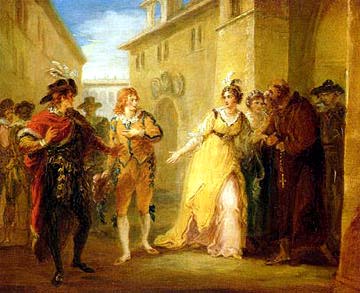
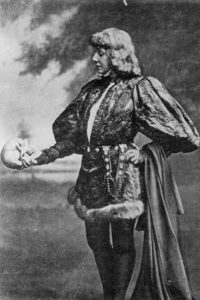 You know what just occurred to me? I don’t recall seeing a single peanut in any of Shakespeare’s works. Perhaps Shakespeare was suggesting that Hamlet was allergic? More importantly could he have found a rhyme for “epi pen” while still getting the meter to come out right?
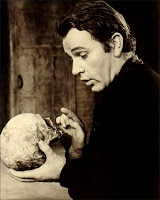 Ok, here we go! The easiest way to review Hamlet, I’ve found, is to break it into three distinct reviews : the direction, the rest of the cast, and Hamlet himself. Otherwise it’s just too hard to separate what David Tennant did with what he was given to work with. Let me just first say that watching Shakespeare on “live” TV as if it were some sort of major event was just awesome. It was this wonderful combination of nostalgia (remember the days before DVR where if you got up to go to the bathroom you missed stuff?) with modern technology – I sat on Twitter and did play-by-play throughout most of the show. Could I have DVR’d it? Sure, and I did, kind of — I was running maybe 45 minutes behind everybody else. But it was important to me to watch it as live as I could, as if we were watching the Academy Awards or something. I wanted to share the experience with my geeks. Great time, and I look forward to what
  Over the years I’ve seen many Shakespeare lists. Instead of linking to yet another one I thought it would be fun to combine several and come up with my own, the Shakespeare Geek Top 10. This is not my opinion, this is the mathematical analysis (according to my own algorithm :)) from a variety of places, some here and some elsewhere, that people have voted on a general “top 10” for Shakespeare’s plays.