
This doesn’t really merit its own blog post but Twitter and Facebook are just a little too small to tell the story properly. I’m currently reading Stanley Wells’ book about love and sex in Shakespeare’s work (I will post a full review when I’m done). I’m actually reading the Kindle version, and I’m reading it on my iPhone. So it’s a little painful, but I knowingly did it that way, because I knew I’d carry around my iPhone into more situations than I’d carry a traditional book. Anyway, there’s a spot where the sentence reads like this: Even so it may be revealing. People masturbate, woo, marry, copulate and give birth. Fine. But in my first reading of this sentence on my tiny screen, what I got was this: so it may be revealing. People masturbate, woo, My first instinct was to read “woo” exactly as we most typically use it these days, like an interjection of excitement, like Woohoo! Only without the exclamation point it’s even better, like Professor Wells is sarcastically letting us know early in the book that he’ll be speaking of grown up topics and we should get over it. People masturbate. Woo. Only after turning the page did I see the marry, copulate and give birth bit, causing me to go back and reparse the entire sentence properly, thus realizing exactly how wrong I was. <shrug> Maybe you had to be there. But I couldn’t not share that story.
Category: Uncategorized
Most of the posts in this category are simply leftovers from a previous era before the site had categories. Over time I plan to reduce that number to zero and remove this category. Until then, here they are. I had to put something in the box.
Do You Grok Shakespeare’s Jive?
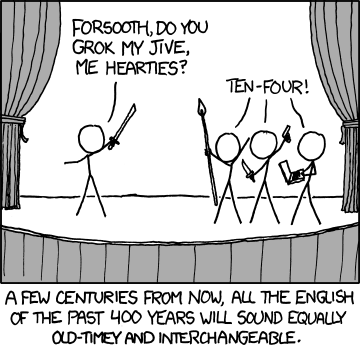
 Geeks of the more technical persuasion will recognize, and probably already saw, this XKCD comic. But I couldn’t resist, for obvious reasons. In case you’ve never been to XKCD, there’s always an extra joke hidden in the rollover text of the image. I’ve not included it here, so click through to the original if you want an extra chuckle.
Orson Welles on Macbeth
Really? How’d I miss this interview between Peter Bogdanovich and Orson Welles when it came around back in April? Great stuff, including discussion about the budget and schedule of Welles’ production, his comparisons to Olivier and Polanski films of the time, and what was up with the Scottish accents. Very long article with great insight into how Welles approached Shakespeare, including excerpts from his book on the subject. Wonderful stuff.
Verbing Weirds Language
I don’t know whether Calvin and Hobbes (who coined my chosen subject line) were in the brain of Erin McKean when she penned this masterful yet subtle slam on a certain recent Shakespeare-wanna-be in the news about how the English language evolves the right way. (In truth, the timing may purely be coincidental, as Mrs. Palin is not mentioned at all in the article. But I like to think it was deliberate…) The subject? Verbing. That is, the use of nouns as verbs. English allows for it, whether you like it or not. I have a blog, I blog things. I also have a table, and I can table things. I look around my office and spy a wall, and technically I could say that I was going to wall my calendar, although what that means might be ambiguous – am I going to hang it up? If I walled my buddha statue that might mean I threw it at the wall. Or I suppose I could lure my enemy down into my wine cellar with the promise of Amontillado and then wall him up down there, too. Grammatically, all valid sentences. Verbing is also at the center of an old grammatical puzzler: “Buffalo buffalo buffalo Buffalo buffalo buffalo Buffalo buffalo”. I think I got the right number of Buffalo in there. Because the word happens to work as a noun (the animal), an adjective (the place from which they come), and a verb, you get such a valid sentence. It’s often hated, no doubt. We all google things and xerox them without too much thought, but sit in a meeting with too many MBA project managers talking about statusing each other or incentivizing their customer base and you may want to beat them with a dictionary. Oh, and one more thing, and I think that this is how and when you correctly drop Shakespeare’s name:
Philip Davis, a professor at the School of English at the University of Liverpool, devised a study in 2006 that tested just what happens when people read sentences with verbed nouns in them–and not just any verbed nouns, nouns verbed by Shakespeare. (Shakespeare was an inveterate noun-verber; he verbed ghost, in ”Julius Caesar, I Who at Phillipi the good Brutus ghosted”; dog, in ”Destruction straight shall dog them at the heels”; and even uncle, in ”Grace me no grace, nor uncle me no uncle.”)
This, too, shall pass
Status: Not Shakespeare
I woke up this morning to this quote making Twitter’s “Top Retweets” section of my feed – that’s when somebody says something that gets repeated by over 100 other people.
Yikes.
This expression is much older than Mr. Shakespeare. To be fair, it was popularized in the West when Abraham Lincoln used it, and he was known to quote a fair bit of Shakespeare. But Lincoln apparently cited his source (somewhat), and it wasn’t Shakespeare he referred to:
(You need to scroll down a bit, the embedded Google books reader will only take us to the page, not the exact paragraph we want.)
So the expression is at least as old as “Jewish folklore” or perhaps a Persian Sufi poet circa 1200A.D. Either way it’s much, much older than Shakespeare.