
The Shrug Heard Round The World

If you haven’t seen the Tennant/Stewart Hamlet yet, read no more!  Spoilers follow about “the thing”.

Here, while you’re waiting, have a look at this completely unrelated clip of the “best death scene ever”…

Ok, let’s talk about this.  Claudius, holding a cup of poison and with Hamlet’s sword to his throat, *shrugs* before voluntarily drinking the poisoned wine.   I called it the biggest WTF moment in a movie full of them. I fast forwarded to that part just so I could show it to my wife, just so I could complain about it to a live person.

Can anybody come up with a logical interpretation for why he’d do that?  For that matter, the final scene is a real character switch for the man.  When Laertes is about to spill his guts (possibly literally), Claudius leaps up and begins frantically waving to have him taken away before he talks.  When Hamlet draws on him. Claudius *grabs the point of the sword*, which is rather unusual, but then at the ensuing booboo on his hand he shows the crowd and says “Help me, I am hurt!” 

I can even live with those, at least a little bit.  I can live with the idea that, once cornered, Claudius is basically a coward.  He has others do his dirty work for him, or he gets you in the ear while you’re sleeping.  But when he personally is called to the carpet?  He panics.  I can accept that.

It’s the shrug where I lose it.  Two seconds ago he was panicking that he’d been caught.  He makes a play to save himself (Help me, friends!), but no one comes to his aid.  So now he goes all stoic and with a “What the hell,” suicides?  No fight at all?  No *flight* at all? If you just declared him a coward, at least have him run for it and get it in the back or something.

Anybody got a justification for this one?
Double Casting?

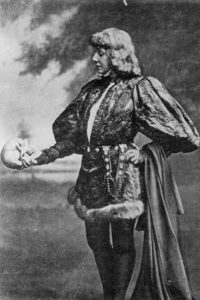
So Patrick Stewart played both Claudius as well as Hamlet’s ghost in the David Tennant production that we’re all still talking about.  I’m told that this is common practice.  Fair enough.  Never really thought about it one way or the other.

My question for discussion, though, is … why?  I understand a live theatre troop having to double up on actors because they don’t have the bodies, or need to keep costs/resources/complexity down or whatever the real world reasons are.  I’m not talking about that.  When you’ve got plenty of budget and big name stars to work with, double casting to begin with is clearly a choice.  To double cast the major roles obviously has a point, such as the fairly obvious one when we see Theseus and Hippolyta double cast with Oberon and Titania in Midsummer.

So then, why Claudius and his brother?  What’s the point of that particular choice?  Is it to show that Hamlet’s issues with Claudius are really unresolved issues with his dad?  Is it to suggest that Hamlet’s dad and his brother were so close in physical resemblance that we can forgive Gertrude for essentially replacing the former with the latter?  Hamlet several times plays up the differences between his father and Claudius (the line “like Hyperion to a satyr” comes to mind), so is it to draw a stark contrast to that, to suggest clearly to the audience that they weren’t really so different after all, and Hamlet just wishes that they were?

Any other “well known” double cast decisions you want to talk about?

Calling Doctor Shakespeare! (Or maybe Dr. DeVere?)

Unfortunately the JAMA article linked in this Washington Post piece about Shakespeare’s medical knowledge is available only to AMA members, so I’m left linking a link of a link :(.

The article points to a piece from the “100 Years Ago” department that ponders how Shakespeare acquired his “extensive knowledge of medical matters.”  Deniers will, of course, tell you that this very sentence is prove that Stratford Will could not have written the plays because he was not a doctor, and we should be seeking out the medical professional who did write them.  (I heard that Oxford once successfully put a Band-Aid onto the pinky finger of his left hand, however.  So he’s still in the running.)

But Shakespeare did know his mental illnesses. The article notes that in his day, mentally ill people weren’t locked away in institutions. Shakespeare could train his powers of observation on people suffering all manner of mental disorders without going out of his way to encounter them.

It’s interesting to periodically step away and look at the words from this “100 years ago” perspective.  We’re so used to what Freud told us about Hamlet that we rarely stop to differentiate what Shakespeare couldn’t possibly have been trying to say (because the very concepts did not exist yet), from what he really was trying to say that we’re not seeing because we fail to look at what he gave us from his own terms.  Would Shakespeare have had a name for the behaviors that he gave to Ophelia? Was he describing what he’d personally seen in someone else?

Since Freud comes so much re: Hamlet, I’ve often wondered what other modern psycho/socio creations we have today that Shakespeare might have been showing us, in his own way.  Does Hamlet, for example, go through the “five stages or grief”? Do any of his characters suffer from textbook schizophrenia?  In my review of Tennant’s Hamlet earlier today I deliberately made reference to Asperger’s (and, on Twitter, ADHD) to see if anybody with more knowledge of those subjects would pick up on the thread.

You know what just occurred to me?  I don’t recall seeing a single peanut in any of Shakespeare’s works.  Perhaps Shakespeare was suggesting that Hamlet was allergic?  More importantly could he have found a rhyme for “epi pen” while still getting the meter to come out right?
[Credit to vtelizabeth on Twitter for the Tweet which pointed me in this direction.]

Review : David Tennant as Hamlet, Nerd of Denmark

Ok, here we go!  The easiest way to review Hamlet, I’ve found, is to break it into three distinct reviews : the direction, the rest of the cast, and Hamlet himself.  Otherwise it’s just too hard to separate what David Tennant did with what he was given to work with. Let me just first say that watching Shakespeare on “live” TV as if it were some sort of major event was just awesome.  It was this wonderful combination of nostalgia (remember the days before DVR where if you got up to go to the bathroom you missed stuff?) with modern technology – I sat on Twitter and did play-by-play throughout most of the show.  Could I have DVR’d it?  Sure, and I did, kind  of — I was running maybe 45 minutes behind everybody else.  But it was important to me to watch it as live as I could, as if we were watching the Academy Awards or something.  I wanted to share the experience with my geeks.  Great time, and I look forward to what PBS has in store for us next time..

Continue reading “Review : David Tennant as Hamlet, Nerd of Denmark”

Not By Shakespeare

UPDATED!  This has become such a popular topic that we’ve spun off a completely new site.  Please visit Not By Shakespeare for the most up to date research into who actually said what.

I was very upset yesterday to discover that in my Shakespeare Day blur I’d retweeted a quote as if it were by Shakespeare, only to later realize it is not.  (Yes, that kind of thing bothers me.  I would much rather answer “I don’t know” to a question, or remain silent, than to be wrong.)  What’s annoying is that if you google these quotes, the vast majority of “sources” on the net will in fact claim them to be Shakespeare, but with no citation.  If you can’t find it in the works (and don’t forget to check Venus and Adonis!), it’s probably not in there.

So I thought now would be a good time to collect some of the more popular ones in one place, and give proper attribution.  At least, disclaimer, I’m giving what I *think* is proper attribution!  Correct me if I’m wrong, and feel free to add what I miss.

“I love thee, I love but thee With a love that shall not die Till the sun grows cold And the stars grow old.”

This is the one I goofed on.  It is Bayard Taylor, from the Bedouin Song.

“When I saw you I fell in love. And you smiled because you knew.”

Arrigo Boito.  (Who, by the way, was apparently famous for his work on the operas Otello and Falstaff!)

“Hell hath no fury like a woman scorned.”

William Congreve in The Mourning Bride (1697).  Shakespeare did say “Come not between the dragon and his wrath,” and “How sharper than a serpent’s tooth it is to have a thankless child” (both King Lear, I believe?), which both seem to be to be of a similar spirit.

“Oh what a tangled web we weave, when first we practice to deceive.”

Walter Scott, Marmion.

“If you can’t get rid of the skeleton in your closet at least teach it to dance.”

Speak of the devil, I saw this one for the first time on the same day I posted this article. How can anyone think that’s Shakespeare? It’s George Bernard Shaw.
It’s worth noting that there’s already at least one other site covering this topic, but two of the ones I list above, that I see on a daily basis passed around Twitter, are not even on that page.  And that one has a whole bunch of stuff that I’ve never seen attributed to Shakespeare.  The list above, so far, are quotes I’ve personally seen attributed incorrectly to our boy in Stratford.

So, the next time you catch somebody forwarding along that “til the sun grows cold” line as if it were Shakespeare, then you smack that person right back down and take away their Complete Works. 😉  And don’t forget to link.  Geek needs the google juice. :)!

UPDATED!  This has become such a popular topic that we’ve spun off a completely new site.  Please visit Not By Shakespeare for the most up to date research into who actually said what.