Why Did Iago Leave Roderigo At Brabantio’s House?

The Shakespeare Answers category is here to answer questions people may have about Shakespeare’s work. If you’re just looking for the homework answers then you’ll find them here. I don’t love that, but I look at it this way. First, I can’t stop you, and if you didn’t find the answer here you’ll easily find it elsewhere. Second, by answering the question here maybe I can convince you that Shakespeare is interesting and worth learning more about.

Like so many of Shakespeare’s plays, we don’t actually see the title figure in the first scene.  Othello opens with Iago and Roderigo standing outside the window of Brabantio, a Venetian senator, and father to Desdemona.

Roderigo lusts after Desdemona, and Iago knows this.

Desdemona has run off with Othello, and Iago knows this.  Iago does not like Othello, to put it mildly.

Brabantio will not be happy to discover that his daughter as run off with Othello, and Iago knows this.

Iago’s manipulation drives everything in this play. He wants to get Othello in trouble, possibly to the point of having his command stripped, and sees an opportunity to use Roderigo as a puppet in making that happen.

So here we are, standing outside Brabantio’s window when the two begin hurling some of the vilest, most racist comments you’ll find in all of Shakespeare:

Even now, now, very now, an old black ram
Is topping your white ewe…

…the devil will make a grandsire of you…

…you’ll have your daughter covered with a Barbary horse…

It is Iago, not Roderigo, that hurls all those comments, as well as the most famous one:

…your daughter and the Moor are now making the beast with two backs.

But, here’s the thing.  When Brabantio asks for their names, the only one to answer is Roderigo.  Iago’s not stupid.  Roderigo still thinks that the plan is some version of “we’re going to get Othello in trouble by telling on him,” not fully appreciating the level of psychological manipulation going on.

Once Brabantio comes down the stairs, Iago runs for it.  He tells Roderigo:

…for I must leave you:
It seems not meet, nor wholesome to my place,
To be produced–as, if I stay, I shall–
Against the Moor

Which translates as, “It’s not a good idea for people to see me here, speaking out against my boss.”  Which is true. You can’t play the puppet master once people realize that you’re the one pulling the strings, and then realize that you’ve got strings attached to them as well.

Does that make him a coward? Hurling insults behind the mask of anonymity and then fleeing into the night?  That would suggest that Iago feels some degree of remorse or shame for his actions, which is hardly accurate.

The scene does a great job of setting up both characters. Roderigo is easily manipulated here and will be again.

Would You Rather…

  • See a live stage performance of all of Shakespeare’s plays exactly once in your life, and then never again.

or

  • Only ever see one Shakespeare play (your choice) for the rest of your life, but you get to see as many versions and interpretations as you want?


In other words, is the ultimate value in Shakespeare’s work represented by the variety across everything he wrote, or the infinite variation to be found in each work?

I think I’d take endless versions of a single play. I’ll learn something new from a Hamlet or a King Lear every time I see it, but I’m fairly confident that I could live my life never seeing Timon of Athens or Pericles.  But could I ever pick one play? I can’t even pick one play to make the example!

I confess this is a bit of a trick question, because the only real way you can decide what play you’d want to see forever is if you’ve seen all the plays at least once in the first place 🙂

Pericles, Prince of Tyre

The Crossover Game

I got this idea from a Reddit post that suggested Much Ado About Nothing as a kind of sequel to Romeo and Juliet, by way of the “bride pretends she’s dead” trick, as if it’s Friar Laurence both times, having learned his lesson and getting it right the second time.

That reminded me of all the various Pixar and Disney theories about how all their movies are set in the same universe – such as the princess from Tangled coming to see the princesses from Frozen at the beginning of that movie.

Pick two plays.  Show how some character or circumstance might connect them.  The more off the wall the better!  Go ahead and use whatever was happening in Shakespeare’s real world at the time for ideas as well!

Much Ado About Nothing

Here’s my entry:

Audiences liked the bit in A Midsummer Night’s Dream where a lion almost eats Thisbe. But they felt robbed that there wasn’t more actual violence. So Shakespeare gave them a character actually pursued and eaten by a bear in The Winter’s Tale. In early productions, Oberon and Puck make a final scene cameo as the ones that bring Hermione back to life.


Behold! Behowl The Moon by Erin Nelsen Parekh

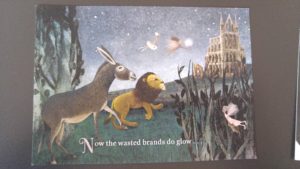
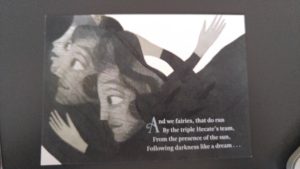
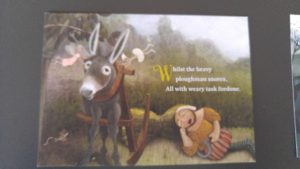
In September 2016 I found this Kickstarter project for a “baby board book” based on A Midsummer Night’s Dream called Behowl the Moon.  Look what came in the mail today!


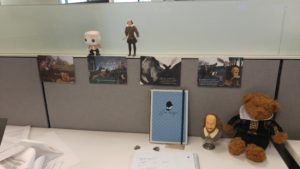
These images came as some lovely postcards representing the illustrations within the book. They’ve now been added to the ever growing shrine at my desk!  New employees rapidly learn that I’m the Shakespeare guy.

I love that this exists, and that we helped make it happen. My kids are too old for baby books now, but there’s lots of new parents out there that can have this. My coworker just had a baby 10 months ago and was happy to pick one up.  “I just hope he doesn’t eat it,” he told me today. “He’s starting to gnaw on everything he can reach.”

If you didn’t get in on the Kickstarter it’s not too late!  The book is available on Amazon in both Kindle and “board book” formats.

In a different world I might have read this book to my kids.  Instead I get to do this. I love it.

Here Come The Shakespeare Bots

All my life I’ve been heavily invested in two things — technology, and Shakespeare. When I first learned to program a computer, when I was blindly typing in code from a book I got from Radio Shack and trying to figure out what it did, one of the programs was “Eliza”, what we now would call a “chat bot”. The first thing I did with it was find the code that recognized the string “Hello,” so that it could respond with “Hello” back. I altered that to understand “Hi, Hey, What’s up, How’s it going?” and so on.  Then applied that same idea to all the canned responses (“yes” became “yes, yup, sure, absolutely, definitely, you know it….”  You get the idea).  I’ve known all my life that the secret to making a computer seem more intelligent than it is, is to mix up the responses.  “When you say X I say Y” is how a computer acts.  “You say one of [10 different X’s] and I say one of [10 different Y’s]” is far more interesting because now you want to play with it. You put more thought into how you interact with it, and you listen more closely to the answer because you’re not sure what it’s going to be.

Getting to college and getting into Shakespeare didn’t change anything, and
This caused me to think a lot about the idea of context, and seeing the world through different eyes. Imagine asking Romeo to describe the big fight scene, and then asking Tybalt or Mercutio to describe it. They have different knowledge of the world, so their actions and motivations are different. You can’t just code that Romeo and Juliet get married at a certain point, you have to code that only Romeo, Juliet and Friar Laurence have that knowledge. I’ve tried to code a program to do this many times, but usually get stuck on “I would have to focus on making this work for just one play” and then never being able to decide whether Romeo and Juliet or Hamlet would be the best one to do.

As I went through courses and got my CS degree and learned about the basics of artificial intelligence, I would always use Shakespeare’s works as my knowledge base.  Polonius is a father. Ophelia is a daughter. Father is a type of parent, daughter is a type of child. When a parent dies, a child is sad. Therefore when Polonius dies, Ophelia is sad.  That’s a gross oversimplification, but I hope you get the idea.  I am constantly looking at the plays in terms of action and relationships between the characters and thinking in the back of my head, “Could a computer be made to understand this such that it could have a conversation on the subject?”

I’m torn now that “bot” is the new buzzword and every website is sticking a “chat” interface on their front end. Most of them are terrible and do little more than replacing a form and a text field with a whole sentence to type.  The whole idea of a bot is that it’s supposed to gather and process information in an interesting, useful and intelligent way.  The natural language thing is really just a twist to the interface, but everybody gets excited about it because it feels closer to actually talking to another intelligence.

All that to get to this link that asked, “Want to chat with Shakespeare?” Yes please.  But then the subtitle reads, “AI bots will soon allow us to talk to the dead.”

Wait, what? No they won’t. The article even acknowledges this – you create a bot by looking at the body of *knowledge* you have about how a person thinks and communicates. We have *zero* of that for Shakespeare.  You can’t use his plays for that, any more than you can use Prince’s song lyrics to simulate him (which is covered in the article).  The article even says that the farther back you go in time, and the less first-hand knowledge you have, the harder it will be to make a bot.  No kidding, so then why did you use it for your title?  Bait and switch much?

I will never lose my fascination with the idea and hopefully, I can contribute to the knowledge on the subject one day. I don’t think most of the bot revolution is going in this direction, I think it’s more about personal assistants.  When all you ever do is ask questions or make commands, the universe of possible responses is extremely limited. It’s the same reason that they used to use chess as a measure of artificial intelligence. Even though the constraints of the system are significant, there’s still a massive amount of computation that goes on in the middle.  So today I can say, “Alexa, what’s on my calendar today?” or “Alexa, add milk to the shopping list.”  But imagine being able to say, “Alexa, my boyfriend killed my father.”  What do you think the response would be?  Probably to call the police, but that’s a different story.