To me, Shakespeare is all about his words. Take away his words and you’ve gone down an interesting path, but not a particularly deep one. Doing a Romeo and Juliet story and calling it Shakespeare is like doing a Cinderella story and calling it Disney. Those are really just cover versions of much older stories.
Category: Shakespeare Plays
William Shakespeare is widely regarded as one of the most influential playwrights in history, and his plays have been performed and studied for centuries. From the timeless tragedy of Romeo and Juliet to the hilarious antics of A Midsummer Night’s Dream, Shakespeare’s plays continue to captivate audiences around the world. Whether you’re a fan of tragedy, comedy, or romance, there’s a Shakespeare play for everyone. So why not revisit these timeless classics and discover the magic of Shakespeare for yourself?
Browse the entire text of Shakespeare’s plays right here on Shakespeare Geek.
Review : A Thousand Acres
Bardfilm and I have been discussing “modern adaptations” lately, and I asked for the distinction – did he mean modern setting but original text, or modern language? For this particular context he meant the latter. Since I don’t normally seek out such movies I went out and found one – the King Lear adaptation of the book of the same name, A Thousand Acres.
Jason Robards plays our Lear (“Larry”, as it becomes apparently quickly that the author’s gone with a whole first initial thing) to his daughters Michelle Pfeiffer (as “R”ose), Jessica Lange (as “G”inny) and Jennifer Jason Leigh (as “C”aroline). From that point it’s harder to tell who is who because unless I’m missing something the first initial game goes out the window as Colin Firth’s Jess is plainly the bastard Edmund. As you can see, though, the cast is first rate.
For any “modern adaptation” of this sort that’s clearly only taking inspiration from Shakespeare and not trying to tell his story, I look for a couple of things. How much direct homage to Shakespeare is there? How much of the original story remains? How much new material does this story provide?
In other words does the end result produce something standalone, while still showing respect for the original? It’s very tricky to strike a balance, because every time you diverge from the source material you’re going to have audience like me asking, “Oh, really? So you think you’re about to tell a better story?” and you need to bring it. Safest not to change the story too much, but instead to bring new elements that Shakespeare never touched upon.
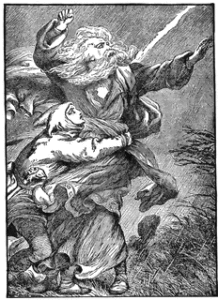
How does A Thousand Acres do? It’s not bad. The connection to the source material is clear, and more than minimal. Larry runs the farm, and wants to retire and divide it up amongst his three daughters. R and G find this a great idea, but when C so much as says “Let me think about it” he disowns her on the spot. I mentioned Jess as the bastard character who does all the bastard things, sleeping with the sisters, getting into a fight with his father (Pat Hingle as this sort of Kent/Gloucester combination character), but he’s not really the architect of all the bad that happens. There’s even a nice big storm for the daughters to send their father into.
Other than those story elements the similarities are few and far between. In this story, R and G (makes me think of Rosencrantz and Guildenstern when I say that :)) are actually the good guys, if you can believe it. It’s a very complicated story. Nobody in town likes them because the people think the daughters conspired to steal the farm from their father. Meanwhile the daughters have both got some deep dark secrets that reveal their father is not the nice man he seems, and is well deserving of their hate.
I found the story too confusing to follow in many parts, and that’s one of the reasons that I often dislike modern adaptations. You try to add your own material, but then to really develop a foundation in that material you have to stray farther (further?) from the original, and eventually you hit walls where you can’t go more in any direction. Same here. There are some obvious places where R and G are talking and it seems like the most obvious thing in the world to do is for them to go talk to C…but they can’t. That’s not how the story went. In fact we never really even get C’s side of the story – this is Goneril’s movie, if I have to pick a central character.
The whole thing is additionally complicated with the addition of husbands and children, alcoholism and terminal illnesses. There’s a whole lot going on in this movie besides the Shakespeare. And it’s all set in this weird sort of Tennessee Williams sounding world where full grown women still call their parents “Mommy” and “Daddy” which, when coupled with the deep dark secrets that we learn, is all the more uncomfortable.
See it if you get a moment, if for nothing else than to have something to talk about the next time somebody trots out one of those lists that contains nothing but Lion King, Ten Things I Hate About You and She’s The Man. But don’t go out of your way for it.
Ghost Guy Hamlet
Here’s a different spin on the Hamlet story – Hamlet (and his female pal Veronica Horatio) as modern-day ghost hunters.
It’s brand new so I’m not sure where it’s going to go, but I wanted to give a boost to some obvious Shakespeare geeks who are trying to do something a bit out of the ordinary. Check it out, and subscribe so you can see how future episodes turn out!
The Complete Works of William Shakespeare—in Haiku (Guest Post)
Several years ago, kj (of Bardfilm fame) happened upon a haiku competition. The competition required joining Twitter, and Bardfilm’s first tweet (which won second prize) was a haiku containing the entirety of Hamlet. Since then, kj has periodically added to his collection of Shakespearean haiku—until he created this astonishing set of poems. Let the world take note: The Complete Works of Shakespeare. (Haiku by Bardfilm).
The Complete Works
Hamlet
The Winter’s Tale
The Tempest
Macbeth
Richard III
As You Like It
King Lear
Romeo and Juliet
The Comedy of Errors
Love’s Labour’s Lost
Love’s Labour’s Found
Titus Andronicus
Julius Caesar
Othello
Timon of Athens
Antony and Cleopatra
Coriolanus
Merry Wives of Windsor
Richard II
Henry V
Pericles
1 Henry VI
2 Henry VI
3 Henry VI
1 Henry IV
2 Henry IV
Two Gentlemen of Verona
A Midsummer Night’s Dream
Measure for Measure
Merchant of Venice
Henry VIII
The Taming of the Shrew
Two Noble Kinsmen
King John
Much Ado About Nothing
Troilus and Cressida
Twelfth Night
All’s Well That Ends Well
Cymbeline
Our thanks for this guest post to kj, the author of Bardfilm. Bardfilm is a blog that comments on films, plays, and other matters related to Shakespeare.
Bard Cake!
I would kill to see Cake Boss do an episode like this – a cake full of Shakespeare’s most famous characters.
Of course, much like Cake Boss, making something out of cake technically means making it out of chocolate, sugar, rice krispy treats and then sitting the sculptures on top of said cake. But, still!
Here’s your challenge, Shakespeare geeks! The opening picture in the article shows the entire cake. Then, each character is explained. So before you scroll down to read the whole article, see how many characters you recognize.
I just love that somebody’s pursued by a bear. I want to meet whoever made this cake.
UPDATE : It appears that Romeo is being pursued by a bear? Although in fairness it could be a kangaroo. Also, who is the snowman looking royal dude on the lower level supposed to be, Hamlet’s father’s ghost? The rest seem pretty recognizable. Note the arras with the blade sticking out of it.