More log-looking shows me that Romeo’s actually the most popular character to ask about. Which I suppose is only logical, as he’s most likely to be on a high school homework assignment. Since Google tells me that “Why does Romeo …” is the most popularly phrased question I thought I’d kill many birds with one stone and make a quick reference.
(For the record, these answers are all off the top of my head so please forgive any misquotes. My point isn’t to write a Wikipedia article, it’s to show that the play can in fact reside in your brain in a perfectly logical way such that you still understand and appreciate the story as a whole and not a connected series of well known quotations.)
Why does Romeo go to the Capulet party?
Put in the simplest of terms, Romeo’s just been shunned/dumped/ignored by the girl he thinks he’s in love with, and his friends Benvolio and Mercutio try to cheer him up by telling him that there’ll be plenty of other girls at the Capulet party. There’s nothing special or tricky about their motivation. They tell Romeo, “Look, we think there are better girls out there than Rosaline, you obviously don’t, so why not come to the party and see for yourself? Rosaline will be there anyway, so you’ll get to check her out compared to some of the other girls and then you can decide.” (For his part, Romeo is humoring his friends while really thinking “Yay I’ll get a chance to see Rosaline again.” He truly has no interest in looking at other girls.)
Why does Romeo hide from Benvolio and Mercutio?
Romeo’s friends have already mocked him once for thinking he was so head-over-heels in love with Rosaline. Well, now Romeo’s in love again – for real this time! – with Juliet. Real love at first sight stuff. And Romeo just knows that Benvolio and Mercutio aren’t going to understand (“They jest at scars that never felt a wound,” he says), he can tell just by the way they’re acting. They’ll no doubt tell him that he’s crazy for falling in love with a Capulet (sworn enemy of the Montague family, by the way), and try to drag him home before he does something stupid. So rather than deal with them at all, he avoids them completely and sets about trying to see Juliet again.
Why does Romeo compare Juliet to the sun?
I’m not about to go into a high school essay type of answer on all of the poetry in the play, I’d be here all day. I’ll just say this – Shakespeare played with opposites to make his point. A lot. As in, all the time, you can’t swing a dead Ophelia without hitting an example of it: “so fair and foul a day I have not seen”, “to be or not to be”, “more light and light, more dark and dark our woes”. (That last one’s actually from Romeo and Juliet, by the way.)
Romeo’s descriptions of Juliet start the minute he sees her — “a rich jewel in an Ethiop’s ear” is another image, once you realize that by “Ethiop” Shakespeare is really referring to an African person, i.e. someone with dark skin, and the jewel he’s thinking of is a pearl – you know, the white one. He keeps trying to paint that “world is dark, she is light” image. He goes on to talk about “snowy doves” hanging out with crows (which are black – you see where he’s going with this?)
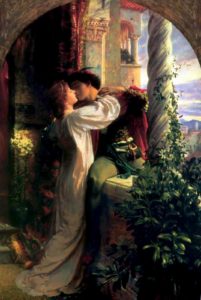
Later in the garden, when Romeo is down on the ground looking up at Juliet against the night sky, he starts by comparing her to the moon but decides that’s not good enough. Sure it makes a nice “white spot against a black background” image like he’s already made a few times, but it doesn’t really hit it out of the park like he’s trying to express. The moon only does a partial job of lighting up the night sky, after all. What’s the real opposite of night time? What *does* have the radiance to banish the darkness? Why, the sun of course. That’s what my man Romeo is talking about. Arise fair Sun and kill the envious Moon. Juliet’s beauty doesn’t just light up the night sky, Juliet’s like the sun, making you forget that it’s even night to begin with.
What’s interesting, in case you don’t get to make this connection, is that Juliet returns the favor for Romeo later in the play during her famous “Gallop apace you fiery footed steeds, toward Phoebus’ lodging” speech. In it she says, “When he shall die, take him and cut him out in little stars and he will make the face of heaven so fine that all the world will be in love with night and pay no worship to the garish sun.” It’s cool because of the obvious parallel, while at the same time being the exact opposite – Romeo paints the picture of Juliet as daytime, while she paints the image of him as glorious night.
Why does Romeo refuse to fight Tybalt?
Short answer? Romeo and Juliet have gotten married, but nobody knows it. Since Tybalt is Juliet’s cousin, that technically means that Romeo is now also family with Tybalt. He has united the Montague and Capulet clans. He’s also downright giddy with excitement about how great life is going, and he’s having one of those days where you can walk up to your sworn enemy, give him a big hug and tell him “No hard feelings,” and seriously mean it because the world is just that great of a place for you right now.
The problem, of course, is that nobody understands Romeo’s real motivation, and everybody interprets differently. Tybalt thinks that Romeo is mocking him, and it only makes him angrier. Mercutio, on the other hand, thinks that Romeo is chickening out of the fight, and that makes Mercutio mad. This does not end well.
Why does Romeo kill Tybalt?
Unable to watch his friend’s honor go down the drain, Mercutio takes up the challenge to duel Tybalt instead. Is Mercutio a bit of a hothead? There’s huge amounts of interpretation to go along with this scene. Was it a bunch of kids fooling around and things got out of hand? Or did they really mean to do each other harm? In a post called Empathy for Tybalt we examined the interpretation of this scene from both the 1968 Zeffirelli version, as well as the modern Leonardo DiCaprio version.
Either way, Mercutio ends up dead and it’s pretty clearly Romeo’s fault. Romeo is trying to break up the fight so nobody – friend or “former” enemy alike – gets hurt. And all he ends up doing is holding Mercutio down, allowing Tybalt to deal the killing blow (whether it was intentional or not).
How’s this got to make Romeo feel? Mercutio was fighting in the first place to defend Romeo’s honor, though technically the roots of the battle were nothing – the “ancient grudge” between the families. They started dueling for no other reason than being Capulets and Montagues. But Romeo basically wiped that slate clean when he married a Capulet. He doesn’t fight Tybalt now just because of his name, he fights for revenge. Mercutio was wrongly killed, and Romeo takes it upon himself to deliver justice. One of my favorite, spine-tingling quotes in the whole play comes when Romeo says, pardon the misquote, “Mercutio’s soul is just a bit above our heads, and you, or I, or both must go with him.” That is seriously bad-ass. You killed my friend, and either you die now or you’re gonna have to kill me too. If Tybalt never meant to kill Mercutio, that’s certainly going to give him cause to worry. He’s not playing around with schoolyard taunting anymore, he’s facing an enemy who, man-to-man, wants him dead and is willing to die to do it. En guard.
Why does Romeo buy the poison?
It’s the ultimate in melodramatic to say, “What will I do without my love? I can’t live without you!” Well, that’s kind of the whole point of the story, Romeo is the king of the melodramatic. Cliches have to start somewhere, and Shakespeare’s audience would have been on the edge of their seats at what these days many of us cynically think of as “Look how stupid these kids were.”
As far as Romeo knows, Juliet is dead. The touching thing about this whole scene is that his response is *instant*. Balthasar, his servant, has mistakenly delivered the news. Romeo asks him several times, “Are you sure? You don’t have any letters from Friar Laurence or anything?” and then dismisses him. His first line when he is alone? “Well, Juliet, I will lie with thee tonight.” He then starts thinking out loud about the best way to do it, and that’s where the poison comes in.
I’m old enough at this point to realize that killing yourself is pretty stupid, but I’m not cold-hearted enough not to see the romance in that. He doesn’t hesitate. He doesn’t say “Whatever shall I do?” There’s been many double-suicide pacts over the years that have gone wrong when someone thinks better of it at the last minute. The fascinating thing about Romeo here (and please remember, kids, he is a fictional character, don’t try this at home!) is that he is single-minded in his determination. This is not going to be easy. It’s illegal to buy poison, first of all. Second of all, he’s a criminal in Verona, so it’s not like he can just walk back into town. The DiCaprio version of the story here is pretty awesome, turning it into an actual police chase as they race him to the tomb where Juliet has been placed.
Why does Romeo kill Paris?
“Tempt not a desperate man!” DiCaprio’s gun-wielding Romeo screams at the cops in his version, and it sums up the situation. He is a desperate man. He’s known only one thing since finding out that Juliet is dead – that he will be with her. “Come Hell or highwater” is an expression maybe you’ve heard? Yeah. That.
Poor Paris gets the short end of the deal in this play. Juliet never really cared about him one way or the other, but no one else did, either. He was never a threat to Romeo, at least not physically. It’s not like he was all about the duel, like Tybalt.
So poor Paris really was in love with Juliet (or at least, what he thought love was, not like Romeo), and has come to her grave to mourn. He thinks that Romeo has come to desecrate (that is, vandalize) the site, and tries to apprehend him. Good old Paris.
Did I mention that Paris was no threat to Romeo? The whole desperate man thing? Romeo actually has a moment of calm here, and tells Paris, “Look. Leave. Live to fight another day.” If Paris was a bit smarter he might have understood what Romeo was up to, as Romeo clearly says “I have come arm’d against myself … hereafter say a madman’s mercy bade thee run away.” If Paris had in fact run away, he could have gone screaming to the nearest authorities “Romeo’s going to kill himself! He’s gone crazy!”
But no, Paris doesn’t get it.
Up until this point, Romeo doesn’t even know who this is, nor does he care. Dude’s in the way. Romeo’s given him a chance to leave, he didn’t take it, so he has to die. It is only after killing him that Romeo has a moment of clarity, recognizes Paris and thinks, “Wait, didn’t somebody say something about Juliet was supposed to marry this guy? Is that why he was here at her grave? Oops.” (Ok, he doesn’t say oops, but he can’t feel good about himself. )
Ok, that’s one of the longest posts I’ve done in a while, hope you all enjoyed it. I like doing stream of consciousness like that sometimes, I actually stumbled over some ideas I’d never had before (like Romeo wiping the Montague/Capulet slate clean, and being the only person in the play to actually fight for a real reason).

 I’m not talking about actors who memorize as part of their job, or geeks who memorize just by experiencing the same passages over and over again. I’m talking about the legions of school-age children who stop by, having been tasked with memorizing the balcony scene or a sonnet or even a passage of their choice, just for the sake of memorizing it.