Venn Shakespeare


Venn vs Euler Diagram
Venn <-> Euler

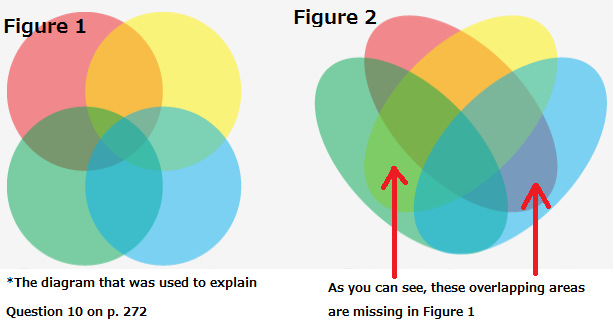
The most popular post I’ve ever made is the one depicting Shakespeare’s works as a Venn Diagram (although technically that shape is an Euler Diagram).  That post on Facebook has garnered over 2 million views at this point, and hundreds of comments. People have asked me if it is available as a poster (as far as I know it is not – I did not create the original image).

The problem is, I don’t like it.  Most of the comments are of the form “Why do you have play X in this category but not that one?” and “You forgot to put Y in the Z category” and so on.  The categories (Suicide, War, Romance, Supernatural) are, I think, too broad.  Does Romeo and Juliet count as war between the two families?  I would say no, but some people disagree.  How about Much Ado About Nothing? It starts with the men coming home from war.

So here’s what I propose.  Can we make a better one, or a set of better ones?  Something that more people can agree on? If we can make something that’s generally agreeable to a large audience I’ll be happy to make it available as a poster / stickers / t-shirt / etc…

I’ve been working with Bardfilm on some new categories.  The goal would be to find a set such that:

  • All plays are represented by at least one category.
  • Minimize the number of categories that have no entries.
  • No single category has too many entries.

What categories would you like to see?  “Supernatural” made our list as well.  I was thinking “Insanity” might be a good one. Bardfilm proposed “Fake Deaths” and “Cross-Dressing”.  If we can’t agree across all the categories we can look at doing one for Comedy, one for Tragedy, one for History, but I think those would end up looking a little sparse, and I’d feel bad about leaving out Romance.

What other ideas have you got for us? Tell us the category you think should be on our diagram, and which plays would be in it.
Shakespeare Storm Quiz

Storm still.

If I scheduled it properly and my software behaved, you should be reading this while I’m sitting up in New England under about a foot of snow.

How often does Shakespeare make a storm of some sort a major plot point?

  • The Tempest, duh.
  • Twelfth Night needs to deposit Viola in Illyria to get started, so a shipwreck seems as good a reason as any. But does the description of how they went down count as a storm, or was it just bad luck at sea?
  • Poor Antonio’s ships in The Merchant of Venice.  Or am I misremembering that? Do we get much of an explanation about how all of his ships go down? I think I’ve always just assumed a storm but not sure my evidence.
  • Macbeth opens with thunder and lightning.  And then there’s Macduff’s description of the night before he arrives at Macbeth’s castle, where it all hits the fan.
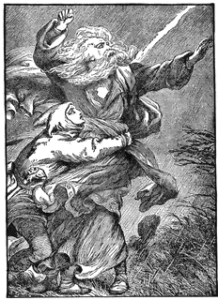
  • King Lear on the heath.  I didn’t realize the power of stage directions until I went back and looked and saw how many scenes say, “Storm still.”  That is a huge storm.

What did I miss?


As You Can Take It Or Leave It

Whenever we discuss Shakespeare’s best or greatest play, some folks will make the case for As You Like It.  Just yesterday on Facebook, in response to yesterday’s “The One Play” thread, one reader suggested that it is “at least as good as Hamlet.”

I don’t get it.

I don’t think it’s a bad play, necessarily.  But that’s not saying much, I’m not sure I’d say that any of them are bad.  But there are some that, if I never saw again, I think I’d probably be ok.  I’m not a Love’s Labour’s Lost fan, or All’s Well That Ends Well or Two Gentlemen of Verona.  There are other potential candidates, like Merry Wives of Windsor, that I’ve simply never seen live.

But other than general agreement that Rosalind is one of Shakespeare’s strongest female leads?  As You Like It is right in that “It’s fine, I guess” category for me.  There’s no real conflict or drama, the plot is ridiculously convoluted, the ending entirely unbelievable.  The only real laugh out loud moments for me come during the exchanges between Jaques and Orlando.

Give me Twelfth Night any day if you want a strong female lead dressed up like a boy.  That one’s not afraid to play with some dark edges, like what they do to poor Malvolio.  His ending certainly isn’t happy.  Does anybody know WTF we’re supposed to take from a character whose last line is, “I’ll be revenged on the whole pack of you”? That’s the kind of thing somebody says before coming back with an automatic weapon.

So let’s have the alternate argument?  We’ll call it the Battle for Cross-Dressing Shakespeare.  I suppose we can go ahead and throw in Portia from if you really want to go down that path, but I don’t really think of her as the “female lead” in the same way as a Rosalind or Viola.  But, your call.


Reddit’s Favorite Shakespeare

Hello /r/Shakespeare!Anybody that knows me knows that when I see a post titled 1000 Most Mentioned Books on Reddit (or, really, anywhere), the first thing I’m going to do is search it to see where Shakespeare shows up.  Any guesses?
I’d love to say more about who made the list and why and how, but there doesn’t seem much to go on. The post, on Medium, was made by BookAdvice.  Have to look more into that, see what other cool lists they have.  All we know about the methodology is, from the summary, “Sorted based on the number of upvotes and the number of different users linking to them in post and comments.”  I suppose that’s got a certain chronological bias — a book that came out last year couldn’t possibly compete with those that have been around since before Reddit.  But it does say “most mentioned” and not “best” or “most loved” or anything like that, so I suppose it’s accurate to say that a book that has existed for ten years will typically be mentioned more than a book that’s only existed for one.

Much of the list is highly predictable, if you know anything about Reddit.  Lord of the Rings, Game of Thrones, Hitchhikers’ Guide To The Galaxy all rank in the top ten.  I’m pleasantly surprised to see To Kill A Mockingbird in there, and The Count of Monte Cristo (though not so pleasantly Catcher in the Rye.  Really, reddit?)  Thrilled to see J.K. Rowling’s name not appear until well after the 250 mark.  Not that her work is bad, just that I’m tired of seeing such brand new books always top the lists of “all time classics”.

Ok, you want the data?  Drum roll, please. Presented in reverse order, from least to most mentioned, we have …

905. The Taming of the Shrew

754. The Tempest

674. Merchant of Venice

625. King Lear

578. Much Ado About Nothing

568. Othello

371. A Midsummer Night’s Dream (*)

295. Macbeth

237. Romeo and Juliet

and the most mentioned work of William Shakespeare on Reddit is……

144. Hamlet

What do we think, any surprises?  Surely not the great tragedies, I think those became self-fulfilling long long ago.  Is Romeo and Juliet popular because it’s so good, or is it considered so good because it’s popular?  Little surprised about Othello, that one doesn’t usually get much love, and I’m kind of wondering if they took the time to rule out references to the board game.

When I first made this list, searching for the word “Shakespeare”, I was surprised to see A Midsummer Night’s Dream not make the list.  I had to go back and double check.  It’s because they’ve got it listed by, and I’m not kidding, SparkNotes.  I wondered if there were many on the list marked this way, but it turns out that’s the only one.  Glad I checked, I almost missed it!

Anything you think should be on the list that’s not there?  Hey, wait … where’s Twelfth Night?


If Music Be Whose Food Of Love?

If music be the food of love, play on.

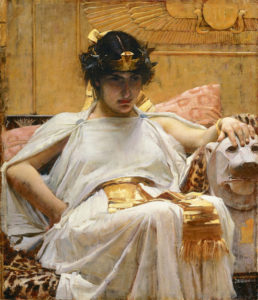
Cleopatra doesn't look very hungry for the food of love.Everybody knows that quote, right?  Duke Orsino, opening line of Twelfth Night.

But check this out.  I was searching the text for music references tonight and a line popped up I’d never noticed before:

Give me some music; music, moody food
Of us that trade in love.

Recognize it?  That’s Cleopatra, from Antony and Cleopatra (duh), Act 2 Scene 5. Sounds almost identical, doesn’t it?  I love finding these obvious examples where Shakespeare had good luck with a particular turn of phrase and went back to it later.

It would be great if A&C was written first and we could say the most famous use of that line actually lifts it from the other, but that’s not the case – Twelfth Night is pretty safely several years prior to A&C.