
Hooked on Shakespeare

Both dead.Challenge:  Can we come up with “hooks” for Shakespeare?

Normally when somebody mentions a hook today they’re talking about music, and that short repeated musical phrase (possibly not even words) that gets stuck in your head.  Chances are when you hear the song again on the radio you don’t even recognize it the first few times until you hear the hook and you say, “Oh, yeah, this is that song, I love this song.” Know what happens, though?  You recognize more of the song each time.  You pay attention to the words. Before you know it, you can recognize it from the opening notes.

But the actual definition, at least according to Google, is

a thing designed to catch people’s attention.

So I’m wondering if we can’t come up with a hook for Shakespeare’s various plays. I saw a teacher complaining earlier that he’d given the students No Fear Shakespeare and yet still found himself having to translate that for them. I thought, “We’re doing this backwards. We hold the text up to be the Holy Grail and then we say let me make it simpler for you, let me make *that* simpler for you, let me make that simpler for you…” and all the materials are in that context of “Here’s how far removed you are from the actual good stuff.”

Let’s change the perspective.  Can you reduce Hamlet down to a single sentence?  I don’t want to summarize all the elements of the play. What I want is the students’ attention. I want them saying, “Sounds interesting, tell me more.”

I have this image like something out of a movie, the harried English teacher walking down between the desks while the kids sit on their phones, throw paper airplanes, and generally ignore him. The teacher is holding a copy of the complete works.  He gets to his desk, turns, and slams the book down on his desk to get their attention.  And he says …  what?

Sure, he could go with, “Two households!  Both alike, in dignity.  In fair Verona where we lay our scene.” And if you’re like me lightning bolts shoot up your spine because that happens every time. But he doesn’t have a classroom full of Shakespeare geeks, and he needs to hook their attention some other way.

“Girl meets boy at party. Two days later they’re both dead.”

“Hamlet’s dad is gone and he wants to kill his step dad.”

“The only person that knows Macbeth just killed his boss is Macbeth’s wife, because she told him to do it.”

“Everybody knows Beatrice and Benedick love each other, except Beatrice and Benedick.”

As I write these I realize it sounds like click bait, but I don’t want to call it that.  Clickbait implies trying to trick the user into looking under the covers for something that’s not really there. But everything I said above is true. I *want* my students to be interested in what happens next.

Anybody else got some good ones?  The goal is to have a list of great starters that any teacher of Shakespeare could use to kick off a new lesson.



With All My Heart

If you’re a geek in the more traditional sense of the word, sometimes you look at the works of Shakespeare as one big text file and say, “Ooh, let’s look for patterns.” If you were to take a course on natural language programming, chances are very good that one of the first lessons will be in parsing Shakespeare for what are called n-grams, or “phrases of N words that always appear together.”  This is how autocorrect works, it looks at what you’ve already written and then says, “Statistically, what do I think is typically the next word?”

But being Shakespeare geeks as well, we can then work backward and look at the context for when and where and why he used them. This post is just one in what’s hopefully a series of interesting discoveries using this technique.

For my fellow programming geeks – here’s the github source I found to get started!

Disclaimer – raw text processing has lots of issues.  Special character and line breaks and headers/footers all get in your way and have to be stripped out.  In one version of this test the phrase “a midsummer nights dream” ranked very highly and I thought, wait, no it doesn’t.  That’s because one of the sample text files had used the title of the play as a header on every page.  Very hard to strip that out if there’s no real markers to identify it.  So, take these results with at least a few grains of salt.

The longer the n-gram that less data you get, which makes sense because you’re going to get fewer hits.  So typically you see 2 or 3 words (bi- and tri-grams, respectively).  But Shakespeare’s a bit wordy and you tend to get things like, “I pray you” or “I know not” which don’t give you much to work with. So I expanded to look at 4 and 5 word grams. Quads and quints?  Not sure what they’re officially called.

My quad-grams give me plenty of the usual hits: “I know not what”, “I do not know”, “I do beseech you,” … but one of them appears significantly more than the others (30% more actually), and it is where I got the title for this post.

With all my heart.

Lovely.  Now can you guess which play uses it the most?  I’ll give you a hint.  Merchant of Venice uses it 4 times, Othello 5, but this play uses it 6 times.

I’m not giving the answer here, I want to see what people guess.  It’s not one I would have expected.  I wonder if it has something to do with when the play was written relative to Shakespeare’s career. Maybe he had a tendency to repeat himself or use simpler go-to phrases earlier in his writing? Is that a hint?

Most Overused Audition Monologues

Not an actor myself (I may have mentioned that), but if you asked me what the most overused Shakespeare audition monologue is I wouldn’t go with “To be or not to be…,” I think I’d go with “All the world’s a stage.”  You don’t


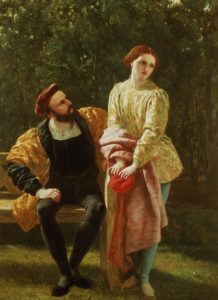
Viola and Orsino

always have to swing for the fences, sometimes a base hit is fine.

I just discovered Backstage.com that has a huge collection of Shakespeare pieces, including their list of audition pieces you shouldn’t use. All the greatest hits are there – winter of our discontent, Romans and countrymen, damned spots, as well as the two I mention above.


But there’s at least one surprise on the list: left no ring with her: what means this lady?

I left no ring with her: what means this lady?
Fortune forbid my outside have not charm’d her!
She made good view of me; indeed, so much,
That sure methought her eyes had lost her tongue,
For she did speak in starts distractedly.
She loves me, sure; the cunning of her passion
Invites me in this churlish messenger.
None of my lord’s ring! why, he sent her none.
I am the man: if it be so, as ’tis,
Poor lady, she were better love a dream.
Disguise, I see, thou art a wickedness,
Wherein the pregnant enemy does much.
How easy is it for the proper-false
In women’s waxen hearts to set their forms!
Alas, our frailty is the cause, not we!
For such as we are made of, such we be.
How will this fadge? my master loves her dearly;
And I, poor monster, fond as much on him;
And she, mistaken, seems to dote on me.
What will become of this? As I am man,
My state is desperate for my master’s love;
As I am woman,–now alas the day!–
What thriftless sighs shall poor Olivia breathe!
O time! thou must untangle this, not I;
It is too hard a knot for me to untie!

Really?  This is a common one?

People who’ve had to audition for Shakespeare roles, what selections have you used?  Are they on the list?


Shakespeare’s Worst Fathers

I didn’t want to do a Shakespeare Fathers list because I knew there’d be plenty of others doing the same thing.  That doesn’t mean we can’t discuss it, though. Here’s one for Shakespeare’s Worst Fathers that we can use.

Since it leads with a picture of Lord Capulet (strangely blacking on John Leguizamo’s face, I guess to symbolize that he could be anybody’s father or something?), I thought that they were going to give him the #1 spot. They didn’t, but it was close.

I used to be on the “Lord Capulet is a horrible father” train, but over the years I’ve been convinced that he’s all talk.  For every scene we can point to where he’s the bad guy, there’s one where he’s the good guy.  He’s the one that suggests that maybe Capulets and Montagues can get along. He’s the one that knows Romeo has crashed his party, and not only lets him stay, but turns on his own kinsman Tybalt for getting everybody upset.  He’s the one that tells Paris that Juliet gets a say in who she marries.

True, that last one appears to be fairly empty when she doesn’t choose “correctly”, and true he does basically threaten to beat her, to throw her out of the house, if she doesn’t do what she’s told.  But does he actually do any of those things? Would he have, given the chance?  Or is it all talk?  Is that just the picture of a father with a temper who has never been spoken to that way before? He’s also the guy who was all, “Revive, or I will die with thee!” when he found her body.

Some of the entries on the list I can live with.  Leonato’s “Do not live, Hero. Do not ope thine eyes,” is pretty bad in my book.  I find it hard to allow him the “Sometimes we say things we regret” defense. That one’s pretty bad.

Shakespeare's Worst Fathers
Well, ok, that one was obvious.

The one that bothers me most is Prospero.  Worst fathers? Really?  The reason seems to be that he, like basically every other father in Shakespeare’s time, chose a husband for his daughter.  I mean, sure, he raised her entirely on his own for a dozen years while stranded on an island with magical creatures who weren’t necessarily friendly.  And he manipulated the veryforces of nature to cause a ship to land on their island to return her to the life she deserved.  He also used no magic to charm either Ferdinand or his daughter into the marriage.  On the contrary he chained up Ferdinand and put him to work to test his faith.  I think it’s hard to argue that he’s not one of Shakespeare’s best fathers.


Reddit’s Favorite Shakespeare

Hello /r/Shakespeare!Anybody that knows me knows that when I see a post titled 1000 Most Mentioned Books on Reddit (or, really, anywhere), the first thing I’m going to do is search it to see where Shakespeare shows up.  Any guesses?

I’d love to say more about who made the list and why and how, but there doesn’t seem much to go on. The post, on Medium, was made by BookAdvice.  Have to look more into that, see what other cool lists they have.  All we know about the methodology is, from the summary, “Sorted based on the number of upvotes and the number of different users linking to them in post and comments.”  I suppose that’s got a certain chronological bias — a book that came out last year couldn’t possibly compete with those that have been around since before Reddit.  But it does say “most mentioned” and not “best” or “most loved” or anything like that, so I suppose it’s accurate to say that a book that has existed for ten years will typically be mentioned more than a book that’s only existed for one.

Much of the list is highly predictable, if you know anything about Reddit.  Lord of the Rings, Game of Thrones, Hitchhikers’ Guide To The Galaxy all rank in the top ten.  I’m pleasantly surprised to see To Kill A Mockingbird in there, and The Count of Monte Cristo (though not so pleasantly Catcher in the Rye.  Really, reddit?)  Thrilled to see J.K. Rowling’s name not appear until well after the 250 mark.  Not that her work is bad, just that I’m tired of seeing such brand new books always top the lists of “all time classics”.

Ok, you want the data?  Drum roll, please. Presented in reverse order, from least to most mentioned, we have …

905. The Taming of the Shrew

754. The Tempest

674. Merchant of Venice

625. King Lear

578. Much Ado About Nothing

568. Othello

371. A Midsummer Night’s Dream (*)

295. Macbeth

237. Romeo and Juliet

and the most mentioned work of William Shakespeare on Reddit is……

144. Hamlet

What do we think, any surprises?  Surely not the great tragedies, I think those became self-fulfilling long long ago.  Is Romeo and Juliet popular because it’s so good, or is it considered so good because it’s popular?  Little surprised about Othello, that one doesn’t usually get much love, and I’m kind of wondering if they took the time to rule out references to the board game.

When I first made this list, searching for the word “Shakespeare”, I was surprised to see A Midsummer Night’s Dream not make the list.  I had to go back and double check.  It’s because they’ve got it listed by, and I’m not kidding, SparkNotes.  I wondered if there were many on the list marked this way, but it turns out that’s the only one.  Glad I checked, I almost missed it!

Anything you think should be on the list that’s not there?  Hey, wait … where’s Twelfth Night?