Wrong Play (But I Can Understand The Confusion)

Fun bit of Shakespeare Geekery on Reddit today when I spotted too late this “Tip of My Tongue” post:

In it there’s a specific scene in which all the characters repeat how they feel about each other a bunch of times with all of them stating how they feel affection for one of the people in the group who does not feel for them.

One of the characters may have an injured arm and I think one of them kept on ending the repeating cycle of lines with something like “and I for no man”

I think I remember one of the characters MIGHT have been a girl dressing up as a guy but I’m not completely sure

By the time I spotted this post somebody had replied, “Twelfth Night?” to which the original poster said, “Solved! That’s the one.”  He even shot down suggestions of A Midsummer Night’s Dream and Much Ado About Nothing as not being the correct answer.

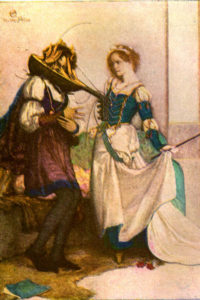
Astute geeks will no doubt see the problem. He is describing, to a T, that other cross-dressing romantic comedy, As You Like It.  Orlando has entered with a broken arm, Rosalind is dressed as a boy, everybody declares their love for the wrong person, and Rosalind is the one who keeps “ending the repeating cycle of lines” with, “and I for no woman”:

SILVIUS
It is to be all made of sighs and tears;
And so am I for Phebe.

PHEBE
And I for Ganymede.

ORLANDO
And I for Rosalind.

ROSALIND
And I for no woman.

SILVIUS
It is to be all made of faith and service;
And so am I for Phebe.

PHEBE
And I for Ganymede.

ORLANDO
And I for Rosalind.

ROSALIND
And I for no woman.

It’s getting so you can’t tell one girl dressed as boy comedy from the next! 🙂


I Said Introduction, Not Induction! ( A Geeklet Story )

My daughter’s in an honest to goodness 100% full-time Shakespeare class now.  It’s been a long time coming.  They’re starting right out with Taming of the Shrew, and already she’s lost.

“I have to annotate the Induction,” she tells me.

I’d completely forgotten about the Induction.  In all the times I’ve told them the story, I don’t think I’d ever mentioned it.

“Oh yeah,” I reply.  “So there’s this dude, Christopher Sly, who is the drunk at the local bar.  It starts out with him arguing with the hostess about breaking some glasses, then he promptly passes out. A lord comes back from the hunt, sees him sleeping in the street, and says, ‘Hey, you know what would be fun? Let’s take him home and dress him in my clothes and tell him he’s actually the lord of the house.’ Have you ever heard the term gaslighting?  They totally gaslight him.  Anyway, he’s not really buying it, until they tell him he’s married, so his first reaction is to say Great! Wife? Let’s go to bed!”

“Oh, charming.”

“Exactly.  They talk him out of it, though. Meanwhile, there are these roving players who run into the original lord and ask if he wants to see a show, so he sends them over to his house to put a show on for Christopher Sly.  That show is Taming of the Shrew.  And, then, basically, Christopher Sly is never heard from again.  Well, he comes back briefly after the first scene or something, but that’s about it. You’re probably going to get tested on why he wrote it, and that’s a good question. There’s a variety of theories.  He didn’t write like that for any other play.”

“Yeah, well,” she says, flipping through her copy, “I didn’t get any of that from this.” Reading, “I’ll feeze you in faith? A pair of stocks you rogue?” She pronounces it “rouge,” like makeup. “How am I supposed to get from that that he’s arguing with the lady at the bar?”

Slowly but surely she works her way through the induction, which she first thinks goes 20 pages until I insist that she read it again and she realizes that every other page is vocabulary, so it’s only 10 pages of content.

So today at dinner she fills me in on how well she fared on that assignment.

“So it turns out,” she says, “that while I was out of class one day last week, she gave out this packet that was an introduction to the play. We were supposed to annotate THAT!”


No Pun Intended

One of my favorite puns in all of Shakespeare can be found in this exchange between Hamlet and Polonius:

HAMLET
‘Tis well: I’ll have thee speak out the rest soon.
Good my lord, will you see the players well
bestowed? Do you hear, let them be well used; for
they are the abstract and brief chronicles of the
time: after your death you were better have a bad
epitaph than their ill report while you live.

LORD POLONIUS
My lord, I will use them according to their desert.

HAMLET
God’s bodykins, man, much better: use every man
after his desert, and who should ‘scape whipping?

I love it.  Hamlet tells Polonius to treat the players well. Polonius responds that he will treat them as well as they deserve.  Hamlet says that if he were to do that, no man would escape the whip.  But the last line can also be read as a play on “dessert”, making “whipping” a play on whipped cream or some other confectionary treat.

Except that it’s not a pun at all. I have been informed by numerous sources that the term “dessert” did not exist for Shakespeare (first published in 1633 according to the OED).  Likewise, “whipping” in reference to confectionary, as in a whipped topping or whipped cream, not until the 1800s.

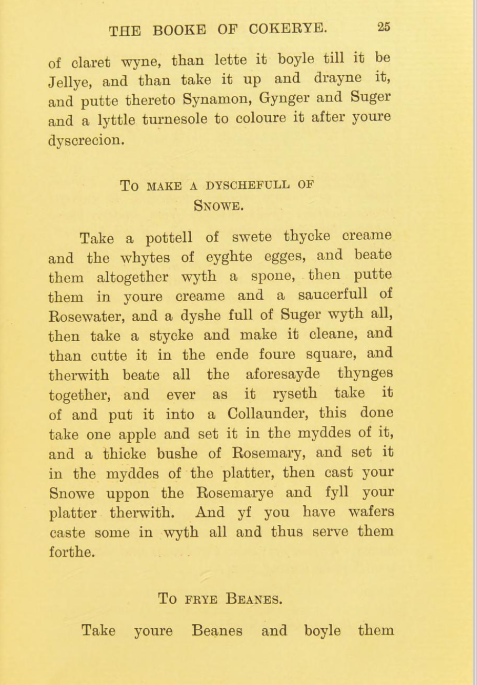
I really wanted this pun to work.  I even did my own research, coming across this recipe for a “dishful of snow”, which is basically whipped egg whites and sugar:

Alas, I have to admit that this is in no way called a dessert, nor does it say to whip anything.  Oh well.  I was actually informed that if Shakespeare was thinking about what we know as dessert, he was probably thinking of something more in line with, “eel baked in Marchpane or lamprey roasted in a sweetened sauce made of its own blood.”  Go ahead and think about putting whipped cream on that!

Anyway, what’s your favorite pun of Shakespeare’s?  I’ll leave you with another favorite that nobody has yet spoiled for me. This one from Two Gentlemen of Verona:

LAUNCE

Nay, I’ll show you the manner of it. This
shoe is my father: no, this left shoe is my father:
no, no, this left shoe is my mother: nay, that
cannot be so neither: yes, it is so, it is so, it
hath the worser sole.


Badly Translated Shakespeare is Awesome

So I spotted a post on Reddit that was clearly in a language I did not know, but also obviously said Hamlet, so I had to check it out. Wasn’t sure if maybe it was a link to a video production I had not yet seen.

Found a wall of text. Thought maybe it was an academic article. So I grabbed the first paragraph and ran it through Google Translate, only to discover that it appears to be your typical summary of Hamlet. Only…wait a second…

The story takes place at the Elsinor Castle in Denmark. Prince Hamlet reveals his father’s spirit and learns the truth that his father has murdered his uncle Claudius, who soon married Hamlet’s mother after his father’s death. Hamlet, who longs for revenge on his father, pretends to be mad.

Ok, this new version of Hamlet sounds awesome. Hamlet reveals his father’s spirit, apparently he was keeping it hidden somewhere. Then we learn that it was indeed Hamlet’s father who killed Claudius! Awesome. Claudius, soon after he was murdered apparently, marries Hamlet’s mother. For pointing all of this out to him, Hamlet wants revenge on his father.

I have to get more of this. I start cutting and pasting more paragraphs:

Because he had no evidence, he organized a theater performance to find out the truth, of course, it was a show of murdering his brother.


Hamlet working out his issues, organizing a performance of him murdering his brother.

Hamlet went to his mother to explain to her how things were and unwittingly kills Poland, the Supreme Chamberlain.


Farewell, Poland. We shall not see your like again.

Claudius was called upon to fight against Lear,

A new player has entered the game! That’s hardly going to be a fair fight, one would think.

Unfortunately the rest of the translation isn’t as good, dissolving into the usual auto translation gibberish. But that was a fun little diversion!

Iago, Not Really Such A Bad Guy?

As regular readers may know my daughter is in her first real Shakespeare class, so we get to have regular discussions about my favorite subject and it almost always results in a blog post.  Technically the class is only half Shakespeare, as it is really “Monsters in British Literature” and The Tempest was one of the topics, which makes this that much more interesting, because Othello isn’t normally part of the class.

So she’s got a writing assignment where she’s to pick a real person (can’t be fictional) that society sees as a monster, and then take a position whether to defend or rebut that argument, using what they’ve learned in class about the “definition” of what it means to be a monster.

We’ve been going back on forth on what (or who) she might pick, when she says to me, “One student did do Iago, though.” I think that may have been for a slightly different definition of the assignment as he’s clearly fictional.  She continued, “But he argued that Iago’s not a monster.”

“Tough argument,” I say.  Normally I’m driving while we have these conversations so I have to keep my eyes on the road.  “Not really sure there’s any evidence on behalf of Iago being a nice guy.”

“That’s the thing!” my daughter responded, “Apparently the teacher read it and said, hmmm, makes you think. Like he actually had a convincing argument, at least to get her to say that much!”

“Yeah, I’ma need you to get me that paper,” I said.

Upon which my daughter freaked out.  “DO NOT EMAIL MY TEACHER, DADDY!” she commanded.  “I know that’s totally something you would do.”

“Yeah, you’re right, there.”

“Please don’t. You can’t just go asking for a random student’s paper.”

“Ok, then you do it.”

“I CAN’T DO IT EITHER!”

“Then I guess we’re gonna have to go Mission Impossible on this one, because I need to see what that argument was.  I’m thinking we lower you into the room on cables, thread you through the laser security, and bam! You get to the file cabinet, you take some quick pictures of his homework, then we yank you out of there. No one’s the wiser.”

“Seriously, Daddy.  You’re not going to email her, are you?”

“No, I wouldn’t do that,” I replied.  “Besides, I’m going to get a blog post out of it either way.”

And here we are!  If we start with the premise that somebody put forth a reasonably convincing “Iago’s not such a bad guy” argument…what could it possibly have been?  Bardfilm sent me a piece from Arden edition which basically takes the position that we should assume everything Iago says is true — being a soldier is all that he knows how to do, it is his life, he seems himself as unfairly passed up for promotion by an unworthy candidate for all the wrong reasons, etc…  It goes on to say that we should assume that, even if Othello isn’t sleeping with Iago’s wife, the important thing to take away is that Iago believes it.  Iago isn’t just making some sort of alibi for his actions.

Personally I don’t see it. And even if we did believe that, it’s kind of like arguing first-degree murder versus third-degree murder. From the start he does show himself to be more sociopathic than that, going right through Roderigo and Cassio like they’re not even people.

<shrug> Anybody feel good taking Iago’s side? See a possible argument that we’re missing?  My daughter has the same teacher for a pure Shakespeare class next semester as well, where they will be reading Othello, so if it so happens that this topic comes up again I will be sure to revisit.