What Would You Do With Twins?

The other day I saw a discussion about how you think a modern Hamlet’s ghost should be staged. My first thought was, “I was the ghost popping up randomly, in the audience, in a way that makes them think it’s impossible for that to be happening.”

My first thought was, “Hologram?” But I put that off as too expensive, but also because the evidence about what was to happen (such as a mini pedestal/stage where he’d appear) would ruin the effect.

Then I thought, “Just have multiple actors dressed as the ghost, so when one exits, another one can appear elsewhere.”  But if they don’t look identical, the effect isn’t the same.

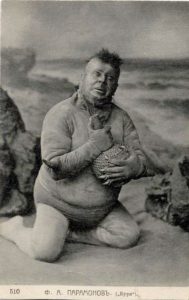
Twins!  Comedy of Errors had twins.  Ok, fine, maybe Shakespeare didn’t actually have twins to work with (did he?)  I know that I’ve yet to see a Comedy of Errors with actual twins.

But that brings me to our question. What if you did have twins in your group? How would you use them?  On the drive in to work today I was thinking about the difference between doubling an actor (Theseus / Oberon anybody?) versus how you’d do it with twins.  If you never have them on stage at the same time there’s no point, so how would you change the staging to take advantage?

How about two Hamlets?  One that devolves slowly into madness (complete with costume change), while the other remains his normal self, silently watching the proceedings. Until at some crucial point late in the play the good Hamlet disappears. (I saw a high school production once with five Hamlets, all on stage at once, all delivering the lines.  It was weird.)

King Lear where Goneril and Regan are twins?  Not sure how much that really changes the story, but it strengthens the bond between them versus Cordelia, and later shows how big a deal it is when they split.

A Tempest where Ariel and Caliban are twins?  I saw a production once where they were handled like conjoined twins, and at the end Prospero separated them.

I’m clearly no director, but I know many of you are. What better ideas can you come up with?  Assume that you can have access to a set of twins of whatever type you need, young or old, male or female.
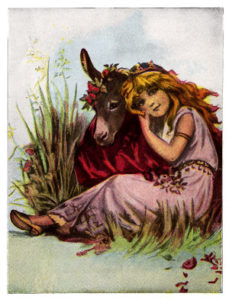
Guest Post : Still Dreaming by Hank Rogerson

Still Dreaming,’ a documentary that in many ways is a sequel to another film I (Hank, not Duane) directed called ‘Shakespeare Behind Bars,’ will premiere on PBS starting this Saturday, April 14.

STILL DREAMING is a multi-award winning film about the powers of creativity, and how engaging in art-making can deeply enrich our lives at any age. 

Filmed at The Lillian Booth Actors Home just outside New York City, where a group of long-retired Broadway entertainers dive into a production of Shakespeare’s A Midsummer Night’s Dream and find that nothing is what it seems to be. With a play that is usually about young love and sex farce, this ensemble finds that for them, the themes of perception, reality and dreaming deeply resonate. 
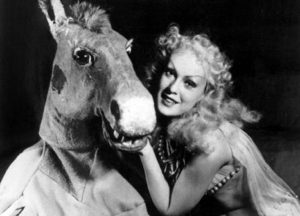
This wistful, honest, and frequently hilarious documentary follows the rehearsals as opening night approaches. Tempers flare, health concerns abound, and disaster seems imminent. But as these former entertainers forge ahead, they realize that creativity is a magical force of renewal.

This whole film journey started back in 2009, when I went to the Lillian Booth Actors Home to meet with the Shakespeare group there to discuss the possibility of their doing a play and my filming that process. The residents and staff were all very supportive of the idea right away, so the discussion quickly turned to which play they would do. The residents in particular were very enthusiastic about the possibility of re-connecting with their craft, for it was as one put it, “This is my whole life inside, and this is a way of getting all of that back.”

My co-director, Jilann Spitzmiller and I went in with the idea of Romeo & Juliet, but that was met with very little enthusiasm, and so a discussion ensued mostly around comedies, since as one resident jokingly put it, ‘There was enough tragedy in their day to day lives already.’ They did discuss Macbeth, King Lear of course, with its theme of old age, and one point someone suggested The Tempest, but I quickly rejected it since it was the play done in ‘Shakespeare Behind Bars.’ The residents kept coming back to comedies such as Taming of the Shrew, As You Like It, The Merchant of Venice, and A Midsummer Night’s Dream. It was Midsummer that seemed to gain the most backing since it was a comedy, and had an ensemble cast with no real leads. This was good they felt since it wouldn’t fall on one or two actors to carry the whole production, which seemed like too much pressure at their age.
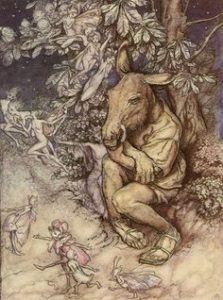
Still, there was quite a bit of resistance from the residents. How the heck would it ever work? A fantastical moonlit forest in a sterile nursing home environment with fairies and sprites leaping around all played by 80-year-olds, and 80-year-olds playing young lovers. How in the world would that work, they wondered. (Jilann and I wondered too!)

At one point in the discussion, a long time pro from film, tv, and theater, who was by far the most experienced actor in the room, spoke up and added, “We have no sets, no costumes, no lights or tech crew. How would we ever do this? And to do it half-ass-ugh, no thanks.” This was met by a prolonged and sinking silence, and it felt like the entire idea of the production was going down right before us. I could sense many of the seniors in the room thinking, “Well if she doesn’t want to do it, then how could we ever go on without her…”
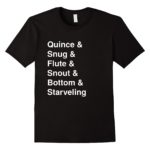
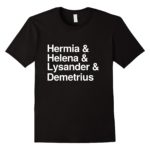

Then another resident broke the quiet and said, “We don’t need a set, we have the outside. Just stand beneath a tree, in a field, and we have spaces indoors in which to work.”

To this, another added, “Yes, all the world’s a stage, and all the men and women merely players.”

A tangible, visible energy moved through the room, a collected sigh of relief that the group could go on, and that this opportunity ‘to get it all back’ might still happen.

And it did.

You can tune into your PBS stations starting this Saturday to watch, or you can stream the film at www.stilldreamingmovie.com.


Review : Sherlock Gnomes

Been there, explained that, bought the t-shirt.

When you heard that the sequel to Gnomeo and Juliet was Sherlock Gnomes and that it would still be the original cast of characters, you probably had the same thought I did. Is there going to be any Shakespeare in this?

The short answer is, “Yes, actually.”  But it’s in a way that most people will find funny, and Shakespeare geeks will groan and eye roll at.

Gnomeo has gone missing.  Dr. Watson has gone looking for him.  “Gnomeo! Gnomeo!” he cries.  “Oh, don’t make me say it.”  Heavy sigh.  “Wherefore art thou Gnomeo?”

It’s at this point that my entire table (we have a local movie theatre where you sit at a table and have dinner) turns to look at my reaction.  I throw my hands up in the air, roll my eyes and say, “Well, at least now I can justify getting a blog post out of it.”


The Great Shakespeare Egg Hunt

With Easter approaching, what do you say we go hunting for eggs in Shakespeare’s work?  I’m not going to list them all here (since it’s easy to hunt them down with a search engine where’s the fun in that?) but I’ll hit the most famous ones.  Add more in the comments!

“Give me an egg, nuncle, and I’ll give thee two crowns.”

Why, after I have cut the egg i’ th’ middle and eat up the
meat, the two crowns of the egg.

When I first tried to read King Lear I couldn’t understand Fool at all.  After many readings and watchings, I think the scenes with Lear, Fool and Kent are my favorite (even if I don’t always understand what he’s saying). He’s one of the few people (perhaps the only one?) who can say to the king, “Hey genius, how smart was it to split your kingdom down the middle and then give away both parts?”

Falstaff 

Take away these chalices. Go brew me a pottle of
sack finely.

Bardolph 

With eggs, sir?

Falstaff 

Simple of itself; I’ll no pullet-sperm in my brewage.

Ok Falstaff, eww.  How am I supposed to look at my kids’ Easter eggs the same way ever again?  (Courtesy Merry Wives of Windsor, for those that don’t remember this charming lesson in animal husbandry showing up in the Henry plays.)  I actually googled this to see if I was missing something and saw it turn up in a list entitled “Why Aren’t These Shakespeare Quotes Famous Too?”


What, you egg!
[Stabbing him]
Young fry of treachery!

Students love this quote, I regularly see it posted when people reading Macbeth for the first time stumble across it. There are web pages and apps and even books dedicated to Shakespearean Insults, but calling somebody an egg just has a special sort of “What did he just call me?” flare to it.

My favorite part is the second line, where he calls him a young fry of treachery.  You know why, don’t you?

Because now he’s a fried egg.


On that note, I’m out of here before anybody gets the pitchforks.  What other egg references have you found?


Nutshell In A Nutshell (A Review)

Alas, poor Hamlet…

I tried to read Nutshell by Ian McEwan about a year ago and couldn’t get into it. I thought I’d reviewed my attempt to do so about a year ago around Shakespeare’s birthday but I can’t find the post.

Bardfilm recommended that I read through the whole thing, as the ending was worth discussing, so I forced myself through it.

Nutshell is a version of Hamlet told with a unique twist – Hamlet is Gertrude’s unborn child.  That’s right, our narrator is a fetus.

In general I’m not a fan of first person narrative,  I think it forces way too many unnatural hoops to jump through to get information to the audience in a way that the narrator would have known. Here that is magnified fifty fold, as our narrator can’t see anything that’s going on, nor can he go anywhere that Gertrude (or, as she’s named here, Trudy) doesn’t go. But that doesn’t stop him from knowing about the plot between his mom and her boyfriend (“Claude”) to kill his father (“John” because I guess there’s no easy way to modernize “Hamlet”). He knows when Claude loans his dad money. He knows what his mom is wearing. He knows where his mom and Claude go on dates, what she eats for dinner, and most importantly, what wine she likes.

Seriously, the wine is a recurring theme. It’s one thing to just say that Trudy is a drunk who doesn’t think that being really pregnant is maybe a reason to cut back. She drinks so much and so often that the fetus himself is a budding oenophile, hoping at different times that his mother partakes of a particular vintage. I hated this part in audio, he really sounds like Stewie from Family Guy.

Also to hate is the amount of sex that Trudy and Claude are having.  It’s a lot. And, since he’s got a front row seat, it’s described play by play and blow by blow by our narrator (who hates it, if that wasn’t obvious). Have you ever wondered what a sex scene reads like when it’s narrated from the inside?  Yeah, don’t.

The most fun part about this book is the way the author tosses in references to the original text, like a treasure hunt. There are so many I can barely remember them, but one easy example was when the narrator said of Claudius, “As a man, he was a real piece of work.”  See what he did there? 🙂  References like that are just all over the book, and if you’re a fan of Hamlet you’ll have a great time trying to spot them all.

There’s not much Hamlet story here.  No Ophelia, Laertes, Polonius, Horatio. Just Gertrude and Claudius, already together and plotting against Hamlet’s father.  At best it’s something of a character study of how the author sees Hamlet.  Sometimes it was as if he was going through a checklist — they like to drink in the original? Check.  Hamlet’s obsessed with how often his mother is sleeping with his uncle? Check.

But at some point you get to interpret for yourself.  Do we like this Gertrude? Is she a good person? How different is she from the original, and how?  What do her actions say about her feelings for the men in her life?

If you like plumbing the depths of the framework Shakespeare gave us for these characters, and get a special little thrill of excitement every time you see a Hamlet reference in a completely different context, then you’ll probably like this one.  I am part of a book club at work, and none of them are really Shakespeare geeks, so I couldn’t see any of them getting anything out of this at all.  One even went so far as to suggest that the author wrote it on a dare, because she’s a fan of his other work.