
Baz Luhrmann’s Romeo+Juliet (sometimes known as Leonardo DiCaprio’s Romeo+Juliet) is getting a Blu-Ray release on October 19. Also released on this date will be the Blu-Ray version of Moulin Rouge (which, if you didn’t know, is also a Luhrmann project, only with Ewan McGregor instead of Leo). I’ll tell you now, if somebody comes knocking on my door offering review copies again, I’m getting a Blu-Ray player! http://www.theatermania.com/new-york/news/09-2010/baz-luhrmanns-william-shakespeares-romeojuliet-mou_30546.html
Category: Shakespeare Plays
William Shakespeare is widely regarded as one of the most influential playwrights in history, and his plays have been performed and studied for centuries. From the timeless tragedy of Romeo and Juliet to the hilarious antics of A Midsummer Night’s Dream, Shakespeare’s plays continue to captivate audiences around the world. Whether you’re a fan of tragedy, comedy, or romance, there’s a Shakespeare play for everyone. So why not revisit these timeless classics and discover the magic of Shakespeare for yourself?
Browse the entire text of Shakespeare’s plays right here on Shakespeare Geek.
Which Play Is The Most Romantic?
Going over edits for my Shakespeare wedding quotes book, I’m curious about which play provided the most romantic quotes. That’s a fairly arbitrary measure, of course, but it’s an interesting question. I’m not thinking of the storyline. I mean, which play has the most passages that you could pull out of context and use elsewhere and still have them sound romantic?
From where I sit, As You Like It and A Midsummer Night’s Dream both have a great deal of stuff to say on the subject of love and romance. But they’re both … light? about it. Neither, in my book, expresses the sort of ups and downs that come with what love’s really all about. Don’t get me wrong, A Midsummer Night’s Dream is damned near perfection from some angles, but half the time, the lovers are in the grip of a magic potion and in love with the wrong person. As You Like It, I find just too corny. Cute but corny. Life’s not as easy as that one makes it out to be.
I think I’ll put my money on Twelfth Night. I love the discussion we had on music being the food of love. Orsino has got some amazing insight about what love’s really all about, and that place where it can actually cause you pain, and yet you still want more of it.
“They are in the very wrath of love, clubs cannot part them.”
“Love sought is good, but given unsought is better.”
They Have Made Worm’s Meat Of Me

Romeo + Juliet (the one with Leonardo DiCaprio) is playing in the background as I work in the home office. Can somebody tell me about Mercutio’s final moments, specifically the reference to worm’s meat?
He is a friend to the Montagues and defends Romeo’s honor in his last act. Yet his last words are, among other things, “They have made worm’s meat of me” and the more recognizable, “A plague on both your houses.”
Help me into some house, Benvolio,
Romeo and Juliet III.i.106
Or I shall faint. A plague o’ both your houses!
They have made worms’ meat of me: I have it,
And soundly too: your houses!
Yes, But What Does Worm’s Meat Actually Mean?
If people find this post looking for an actual explanation of that worm’s meat line, it’s an image that Shakespeare uses frequently. You die, you go in the ground, worms eat you. Look at how Hamlet describes what’s happening to a now-dead Polonius:
Not where he eats, but where he is eaten: a certain
Hamlet IV.iii.22
convocation of politic worms are e’en at him.
Or Sonnet 76:
No longer mourn for me when I am dead
Sonnet 76
Then you shall hear the surly sullen bell
Give warning to the world that I am fled
From this vile world, with vilest worms to dwell:
Pardon the pun, but Shakespeare and the people of the time were down to earth when it came to death. Death was a sad reality; people were dying all over the place. There could be plenty of taken of heaven and angels, to be sure. But when it came to what happens to your earthly remains? Shakespeare was very frank and often pretty gross about it.
Now, Back To Our Story
In this particular version, Mercutio wanders offstage alone when he utters the worm’s meat line as if it is an aside. That changes it for me. I always thought he was saying it to Romeo, referring to the Capulets. But said like that, coupled with the “both houses” line, it seems more that he’s talking about both of them. In his final moments, it is as if he’s wondering, “Why did I get in the middle of that?”
I suppose it’s always been there, and he clearly says both your houses. I don’t think it fully sunk in for me before. He doesn’t blame Tybalt for killing him. He blames them both for getting him stuck in the middle. My point is that the worm’s meat line is more important than the “both houses” line. Imagine for a moment that Mercutio’s not dying. He’s just angry that he’s been wounded for a dumb reason. The “both houses” line can still be hurled at Tybalt and Romeo, but it has more of a “You can both go to hell” edge. But the worm’s meat realization – especially said to himself, where “they” is clearly “both of them”, changes it. Mercutio knows he’s dead. The man with something to say is left with nothing but a curse to deliver.


















Shakespeare Smack Talk
“Shakespeare Insults” is one of the most popular Shakespeare-related topics out there. The problem is that most of those sites are, in fact, just random phrase generators that result in funny-sounding insults that never actually were used in Shakespeare’s works.
Shakespeare is well-known for his sharp wit and clever insults, which have become iconic in popular culture. Some of his funniest and most memorable insults include lines like “Thou art a boil, a plague sore, an embossed carbuncle in my corrupted blood” from King Lear and “I do desire we may be better strangers” from As You Like It. Other memorable insults include “Thou art a flesh-monger, a fool and a coward” from Measure for Measure, and “Thou art a natural coward without instinct” from Henry IV, Part 1. Shakespeare’s insults were often used to mock and ridicule characters who were seen as foolish, vain, or cowardly, and they have since become a hallmark of his plays, adding humor and entertainment to the already rich and complex narratives.
Last night during Othello, I heard one that I don’t think I can call an insult, but it certainly goes under the banner of good “smack talk”. Othello is listening to Cassio talk about Desdemona (so he thinks). Where Cassio cannot hear him, Othello says, “O, I see that nose of yours, but not that dog I shall throw it to.” Nice! Who talks the best game in the works of Shakespeare?
When I saw you I fell in love. And you smiled because you knew.
Status: Not by Shakespeare
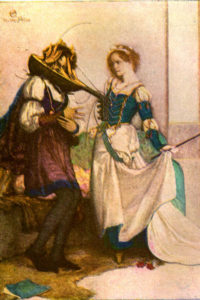
Although often attributed to Romeo and Juliet, Shakespeare aficionados the world over can assure you that neither this line nor anything like it, appears in that play. It doesn’t even sound like Shakespeare. It is by Arrigo Boito, who does at least have a Shakespeare connection in that he’s written a number of operas based on Shakespeare’s work including Othello and Falstaff.
In fact, it’s precisely Falstaff where we can find the original quote (although it’s in Italian):
Come ti vidi
M’innamorai,
E tu sorridi
Perchè lo sai.
which Google Translate tells me is, “How I saw you I fell in love, And you smile Because you know it.” Close enough, Google!
[the_ad id=”9637″]
Hat tip to https://falsescribes.wordpress.com/2013/07/12/when-i-saw-you-boito/ pointing out that the text is from Falstaff, which at least gives us an excuse to make the Shakespearean connection? I wonder if there are folks out there who know that’s the source and are just working backward, figuring that Shakespeare must have written it originally.
Nah. All these quotes fall victim to that same “It sounds sappy and romantic, assume Shakespeare wrote it, it will get more likes on Instagram” logic.
Explore more posts in the Not by Shakespeare category.