Know Your Audience? I Thought I Did!

So this weekend we’re at Shakespeare on Boston Common and I’m waiting in line for the port-a-potties with my kids.  It’s intermission, it’s dark, there’s 20 people in line ahead of us, so you know the condition those things are going to be in.

My son goes in first.  Comes out, tells me, “Daddy, somebody left a wine bottle in there.” The lady in the line next to us laughs.

“Well,” I tell him, “Drink is a great provoker of three things.”

Now, I knew he wasn’t going to get the reference. But I’m surrounded by people who are at outdoor Shakespeare, I expected somebody to get it. I even turned and made eye contact with the woman who laughed in the first place.  I should have gone up for a high five.  She would have left me hanging, but still.

I got nuthin.   I was disappointed.  Who says Shakespeare isn’t relevant today?


What Kind Of Performances Are You Seeing?!

Funny story time.

I was hanging out on a forum that has nothing to do with Shakespeare (more of an entrepreneurial, side-hustle kind of thing).  Since it was definitely not a Shakespeare crowd I decided to ask, “What do you think of when I say the name Shakespeare?”

I got the usual results – “boring”, “old”, “classic”, “exciting”, “men in tights”, “Shakespeare in the park” and so on.  I engaged a few people in conversation, and like these things often do, everything just kind of tapered off.

But then a few days later somebody posted and wrote, “Exhausting.”

So I responded, “Watching it, or performing it?”


And she replied, “All of it. I’ve tried the videos.I can’t believe the poses they expect you to get into. And then when you actually go, somebody’s always coming around and touching you, and that makes me really uncomfortable.”

Wait, what?

Turns out she was talking about yoga.  She’d responded to the wrong thread.

Too bad, for a minute there I was fascinated by what kind of productions she’d been seeing!


What Will Theatre Look Like In 100 Years?

What will theatre, and Shakespeare in particular, look like in 100 years?

When people want to talk to me about who they think is a “modern Shakespeare” I always respond the same way: “Talk to me in 450 years and we’ll see if anybody’s still talking about your guy.”

But it does bring up something that we can talk about.  Shakespeare hasn’t remained static for all that time. The words aren’t changing, but everything else is.  Women on stage.  Electric lights.  Film.  Our attitudes toward race, gender, anti-Semitism.  All up for discussion.

What’s happening now that you think will be standard a generation (or two) from now?

I think that gender and race-blind casting is an obvious one.  I think we could debate all day the difference between “King Lear portrayed by a woman” and “King Lear portrayed as a woman” but that’s a topic for a different day.  Just like men played all the female roles at one point, I have no problem with women playing the men’s roles.  But when you change the actual character – making Prospera the mother figure rather than Prospero’s father figure, or making Hamlet the daughter rather than the son – well, then I think you’ve changed the source material and are now telling a different story than Shakespeare did, and creating a whole new thing. Which is fine, but then you shift into “based on Shakespeare” or “inspired by Shakespeare” territory. Don’t tell me I’m going to see Hamlet and deliver me the melancholy princess of Denmark.

Even that much is typically enough to get Facebook mad at me 🙂 and it’s not really the aspect of Shakespeare that most interests me.  I’d much rather talk about technology.

I’ve wanted to redesign the whole idea of the script for a long time. I wrote about my desire to see “Gonzo” Shakespeare back when the iPad2 first came out. This year we saw The Tempest with a completely computer-generated Ariel.  And let’s not forget this story about Shakespeare via portal, where some of the actors “on stage” are actually being broadcast from a thousand miles away.

What’s next?

Something I haven’t seen yet, but I’d love to see?  Interact with the audience’s smart phones.  A day will come, if it hasn’t already when we can just assume that everybody has one.  Imagine telling people that they can download an app to be a part of the show, just like donning 3d glasses at a movie.  Then comes a scene when everybody exits…then all our phones light up, and you see and hear Hamlet, “How all occasions do inform against me, And spur my dull revenge!”  It needs work, you’ve had to deal with the brightness,

How far we’ve already come!

the volume, etc.. but that’s just one idea off the top of my head as I sit here and write this.  Maybe in 100 years, we won’t even need the device. We’ll just have the sounds and images projected right into our heads.

Moore’s Law tells us that the advancement of technology is ever accelerating.  What’s taken 20 years thus far will take 2 years going forward. So 100 years is a long time.  Can we even imagine?

Almost Forgot – A Midsummer’s Nightmare Tonight!

I was wondering what happened to this one, and it dropped in my lap this morning.  Our “summer of Shakespeare on TV” continues tonight with Lifetime’s A Midsummer’s Nightmare, which is going to be some sort of

horror story so I’m sure there’s not going to be much Shakespeare in it at all. The cast of characters doesn’t list any actual character names, excepting “Mike Puck” and “Nick Bottoms”. Everybody knows that I’m in it for the Shakespeare, so if I don’t hear some original text, I’m probably not going to care for it much at all.

Courtney Love is in this, as is Dominic Monaghan, the guy that played Merry in Lord of the Rings.  If they both end up putting Shakespeare on their resume after this, I know which one is going to sound more believable.  (Although I do see that one of the other stars, Daisy Head, who I otherwise would not recognize, is going to be in the upcoming Ophelia movie next year.  So maybe she’s going to be somebody we see more of in the future.)

I suffered through one episode of Still Star-Crossed, though, so I’ll suffer through this one. It’s not on until 11pm, though, so I might end up recording and watching tomorrow.

Enter, Stage Directions

Today I was asking random people about their thoughts on Shakespeare, and there was at least one expected answer of, “old and hard to read.”  My normal reaction was to go with the “Well, you really need to see it to understand what’s going on, reading is great after you already understand the story and character and now want to get into the details…..” when something occurred to me that I don’t think I’ve ever considered before.

When it comes to making Shakespeare “easier to read” we always seem to go to “modern translation” at worst, or “easy to access glossary and crazy amounts of footnotes” at best. The latter might give the most amount of information to the reader, but it’s certainly hard to “read” anything when your eye is constantly jumping around the page.

When I need an example I often go back to one that Mr. Corey, my 12th grade English teacher, used when discussing Hamlet. There’s a moment when Polonius says, “take this from this, if this be so.” Which makes no sense unless you can see that he is pointing to his head and then his shoulders, in other words, “have me decapitated if I’m lying.”

In this particular case, there’s often (always?) a stage direction that says, “[Points to his head and shoulder]. So it’s not really the greatest example. But is that part of the problem? The incredible dearth of stage directions? For the most part all we get with Shakespeare is who entered, who exited, and who stabbed or killed whom.  You’ve got to be careful, too, because those that are stabbed often stick around for a few speeches before they die.

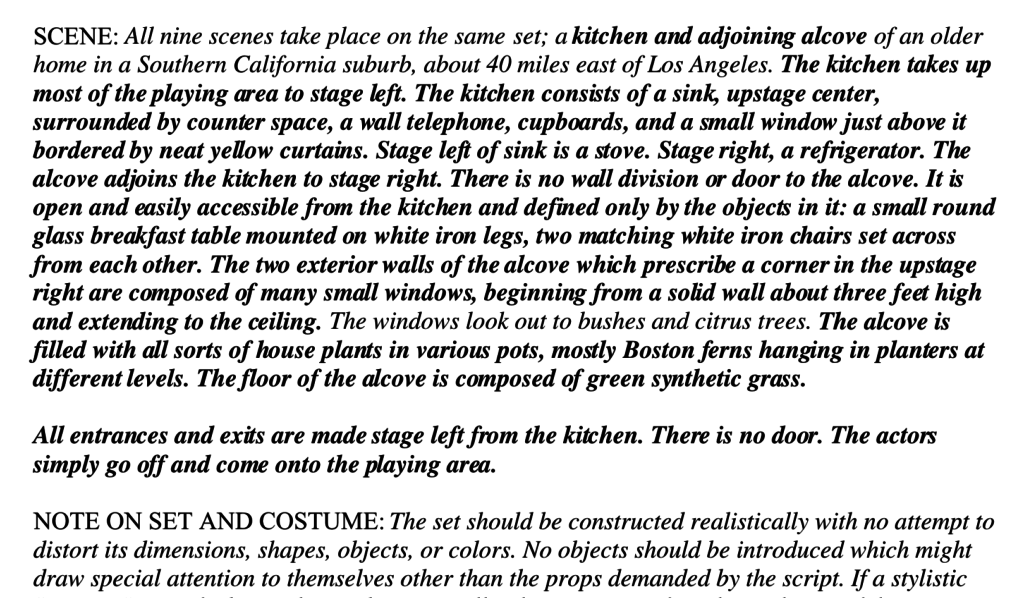
Has anybody published an addition that doesn’t touch the actual text of the dialogue, but instead lays out the context in the stage directions?  Modern stage directions, in my limited experience, seem much more detailed.  For some reason True West by Sam Shepard  is what came to mind, and here’s a snippet of those stage directions (I was unsure if the bolding was in the original, I took a screenshot of somebody’s analysis I found online):

There’s a fairly obvious argument against going down this path in that it destroys the infinite interpretation of Shakespeare that has made him so timeless.  To say “Enter Hamlet, and here’s what he’s wearing, and here’s the expression on his face because here’s what he’s thinking…” is to destroy the character. Or at the very least, to lock one interpretation in stone.  But surely there’s middle ground?  How hard is it to write, “Enter HAMLET, still mourning his recently deceased father, dressed mostly in black.”  Now you’ve got context for “clouds hang on you”, “inky cloak,” “nighted color”, and so on.

Maybe this is how Shakespeare is actually performed, I don’t know.  Maybe the director, in trying to document her vision, does something similar where she has to go through and add notes of description to all the various scenes?